
Epidemiology
Understanding Pandemic Spread and Optimizing Resource Allocation
Spatial epidemiology, outbreak forecasting, and intervention design across human, veterinary, and agricultural settings.
31publications
5lab members, current and past
3collaborators and frequent co-authors
2021–2026years of papers
About the project
What this project is about
Mathematical models and simulations to predict infectious disease spread and guide resource allocation.
This project serves as the lab's umbrella effort for spatially explicit epidemic modeling, public-health decision support, and resource allocation under uncertainty. The work combines extended SIR and SEIR families, room-level and regional simulations, policy optimization, and reinforcement-learning-based control to study airborne outbreaks, wartime disruption, agricultural pandemics, and dual-use healthcare systems. Where data are sparse, we use calibrated mechanistic models and scenario analysis to produce actionable recommendations rather than black-box forecasts alone.
Approach and outcomes
The methods the project relies on and what it has produced so far.
Methods
- Extended SIR and SEIR modeling
- Spatial and room-level simulations
- Optimal control and policy search
- Agent-based modeling
- Deep reinforcement learning
- Scenario calibration and sensitivity analysis
Key outcomes
- Decision-support models for outbreak control under mobility, warfare, and infrastructure constraints
- Resource-allocation frameworks for dual-use hospital and community health systems
- Cross-domain epidemic analyses spanning airborne, zoonotic, and agricultural pathogens
Recent results
Selected findings
A key finding from each of the project's latest papers. Every paper page has the full text, figures and a plain-language summary.
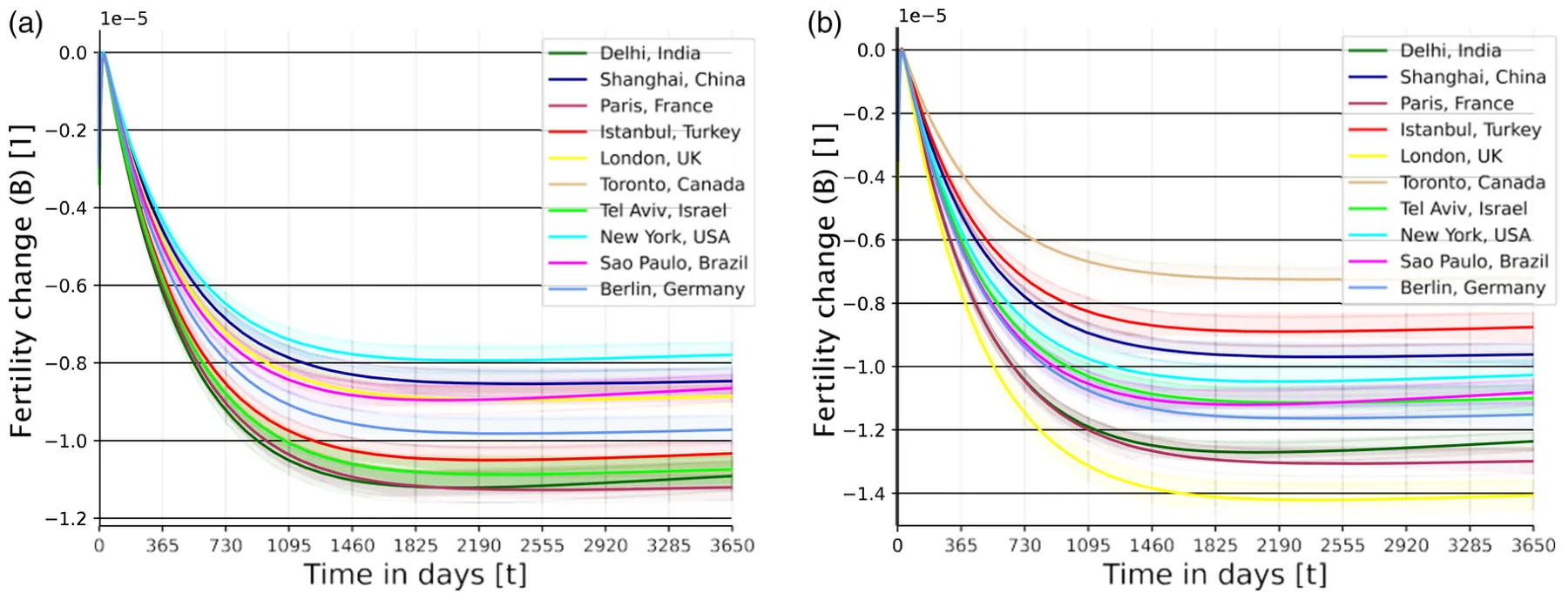
Modeling the effects of pandemics on physiology-related fertility decline in society
Infection-related fertility decline can create demographic ripple effects that last for generations, well beyond the immediate pandemic period.
Read the paper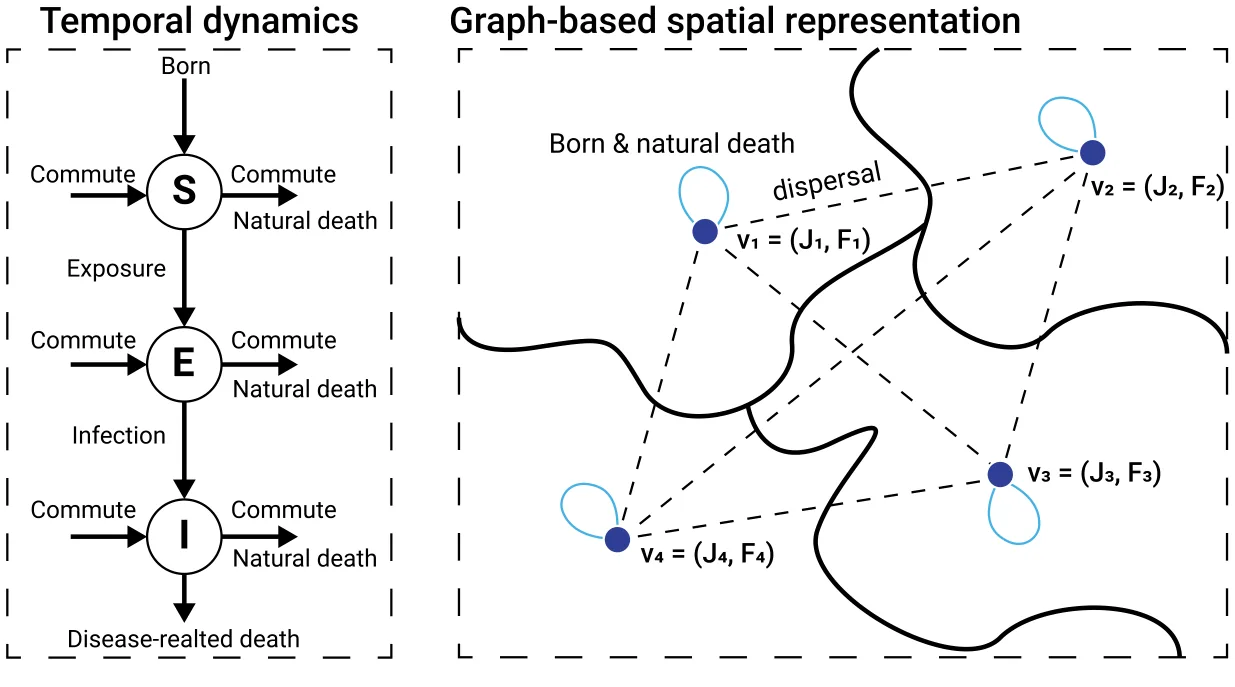
An empirically-parameterized spatio-temporal extended-SIR model for combined dilution and vaccination mitigation for rabies outbreaks in wild jackals
The effectiveness of vaccination and dilution was not influenced much by jackal population size but was sensitive to dispersal between adjacent activity centers.
Read the paper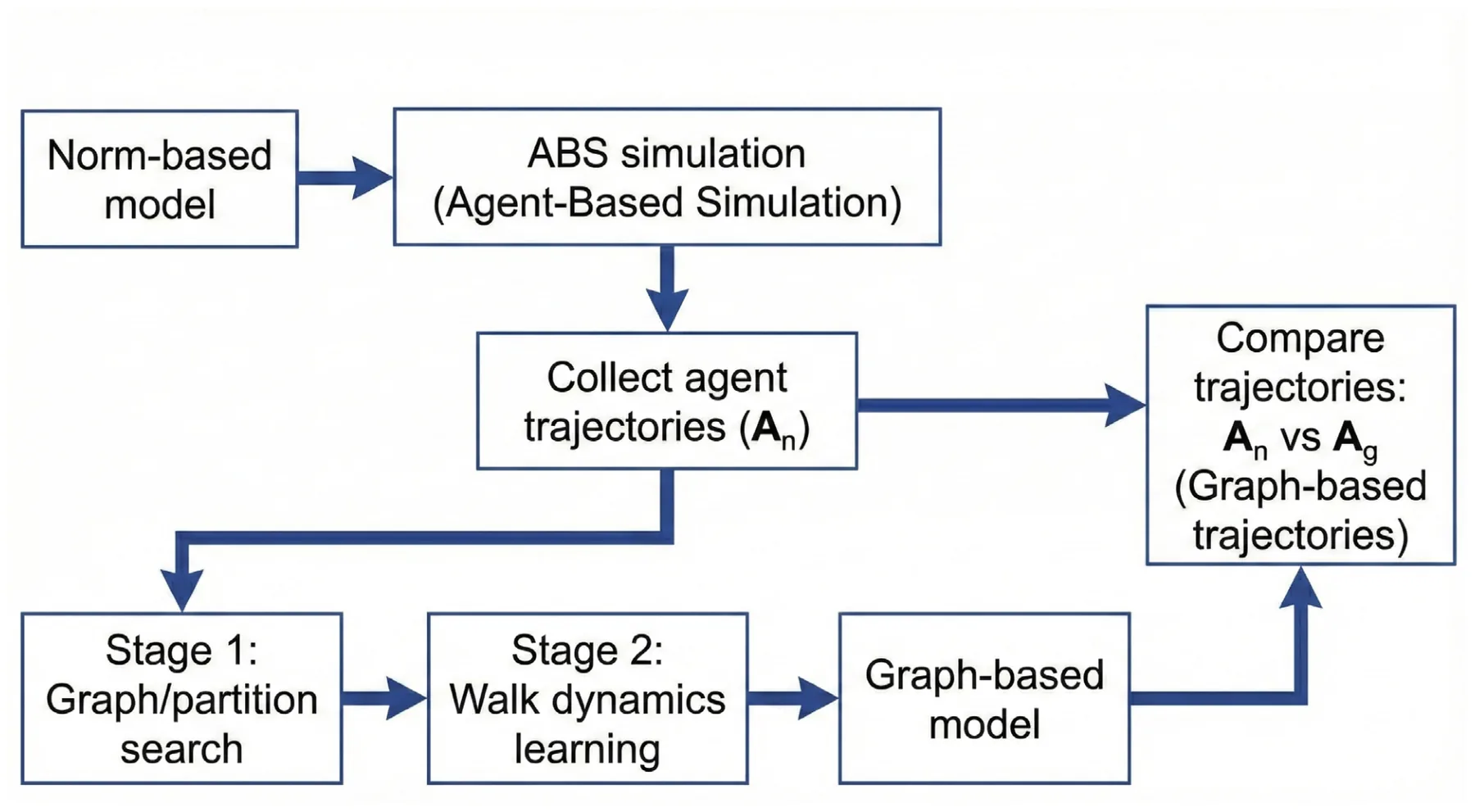
Transforming norm-based to graph-based spatial representation for spatio-temporal epidemiological models
No analytical mapping exists between norm-based and graph-based spatial representations, so numerical approximation methods are required.
Read the paperPublications
Every paper from this project, newest first. Lab members are in bold; each title opens the paper's own page with the abstract, a plain-language summary and, for most papers, the full text.
31 papers
2026 3 papers
- Modeling the effects of pandemics on physiology-related fertility decline in society
Frontiers in Epidemiology · 2026Full text on the site
Pandemics can reduce people's physical ability to have children, but this effect is rarely included when we study how populations grow. We built an extended Susceptible-Infected-Recovered (SIR) epidemic model that tracks age groups, genders, births, deaths…
- An empirically-parameterized spatio-temporal extended-SIR model for combined dilution and vaccination mitigation for rabies outbreaks in wild jackals
Ecological Modelling · 2026Full text on the site
Israeli authorities fight rabies in golden jackals by spreading oral vaccines and by dilution, removing animals to reduce local density, but how these two measures interact is poorly understood. We built a spatio-temporal extended SIR epidemic model on a…
- Transforming norm-based to graph-based spatial representation for spatio-temporal epidemiological models
Engineering Applications of Artificial Intelligence · 2026Full text on the site
Spatial epidemic models come in two kinds: norm-based models, which are more accurate but need more computing and data, and graph-based models, which are cheaper but less accurate. We showed that no exact analytical conversion between the two exists and…
2025 2 papers
- Evaluating supply chain resilience during pandemic using agent-based simulation
Physica A: Statistical Mechanics and its Applications · 2025Full text on the site
Pandemics expose weaknesses in supply chains and leave business owners torn between short-term profit and long-term resilience. We built an agent-based simulation combining an epidemic model, a supply and demand economic model and a spatial supply chain…
- Spatio-Temporal SIR Model of Pandemic Spread During Warfare with Optimal Dual-use Health Care System Administration using Deep Reinforcement Learning
Disaster Medicine and Public Health Preparedness · 2025Full text on the site
Wars and pandemics can occur at the same time, yet how warfare affects epidemic spread is underexplored. We combined the SIR epidemic model with the Lanchester model of war dynamics and added a health care system serving both soldiers and civilians. Using…
2024 4 papers
- Individual Variation Affects Outbreak Magnitude and Predictability in Multi-Pathogen Model of Pigeons Vising Dairy Farms
Ecological modeling · 2024Full text on the site
Pigeons that visit dairy farms can transmit disease to indoor cows, putting livestock, nearby people and other wildlife at risk. We built a spatio-temporal multi-pathogen model, run as an agent-based simulation with field data, that captures transmission…
- Economical–epidemiological analysis of the coffee trees rust pandemic
Chaos · 2024Full text on the site
Coffee leaf rust is a plant disease that reduces coffee supply and quality worldwide, and the interventions on the market give farmers only partial relief. We built a detailed model of how the rust spreads across coffee farms over space and time, together…
- Cost-optimal Seeding Strategy During a Botanical Pandemic in Domesticated Fields
Chaos · 2024Full text on the site
Plant disease pandemics cause enormous economic damage and food shortages, and they are here to stay in the short to medium term. We built a mathematical model linking the spread of a plant disease across a field to the field's economic profit, along with an…
- Mathematical model of dating apps’ influence on sexually transmitted diseases spread
Social Network Analysis and Mining · 2024Full text on the site
Dating apps are designed to bring users back and mostly lead to casual sexual encounters, which raises the number of casual partners. We extended a standard epidemic model, in which infected people become susceptible again after recovering, to study how…
2023 9 papers
- Multi-species prey–predator dynamics during a multi-strain pandemic
Chaos · 2023Full text on the site
Pandemics in nature often start with a single strain of a pathogen and soon become multi-strain through mutation, causing ecological and biological shifts in ecosystems. We propose an eco-epidemiological model that combines the classic Lotka–Volterra…
- The Causal Role of Lockdowns in COVID-19: Conclusions From Daily Epidemiological, Psychological, and Sociological Data
Psychiatric Quarterly · 2023Full text on the site
We asked whether COVID-19 lockdowns themselves drove emotional and behavioral distress. Using daily epidemiological, psychological and sociological data, including support requests to the Sahar organization and emergency and domestic violence reports to the…
- Mathematical model of coffee tree’s rust control using snails as biological agents
Biosystems · 2023Full text on the site
Coffee rust is a major disease of coffee plantations, and snails used as biological control agents are a promising remedy, but they are an invasive species that can be devastating if overused. We developed an ecological-epidemiological mathematical model of…
- Intervention Policy Influence on the Effect of Epidemiological Crisis on Industry-Level Production Through Input-Output Networks
Socio-Economic Planning Sciences · 2023Full text on the site
Lockdowns and border closures during a pandemic disrupt supply chains, and industries depend on each other through input-output links, meaning they buy from and sell to one another. We built a mathematical model with epidemiological, social and economic parts…
- High Resolution Spatio-Temporal Model for Room-Level Airborne Pandemic Spread
Mathematics · 2023Full text on the site
More and more infections happen in shared rooms, yet airborne pandemic models have mostly neglected the scale of a single room. We built a high-resolution model in Python that combines 3D room data from a LiDAR (laser scanning) device, computational fluid…
- Financing and managing epidemiological-economic crises: Are we ready for another outbreak?
Journal of Policy Modeling · 2023Full text on the site
Besides the health threat, a combined epidemiological and economic crisis brings a growing government deficit and a shortage of essential workers. We outline how countries can be economically ready for a future crisis, and a pandemic outbreak in particular.…
- Computational Applications of Extended SIR Models: A Review Focused on Airborne Pandemics
Ecological Modelling · 2023Full text on the site
Mathematical epidemic models help policymakers explore pandemic scenarios and intervention policies, but turning them into practical tools means defining them efficiently, building software and fitting them to historical data. We critically review models that…
- Bounding Pandemic Spread By Heat Spread
Journal of Engineering Mathematics · 2023Full text on the site
Early in a pandemic, policymakers must act while knowledge about the disease is limited, which makes complex models hard to use. We propose analytical and stochastic bounds on pandemic spread based on heat spread, treating infection moving across a social…
- A Hybrid Mathematical Model for Optimal Border Closure Policy during Pandemic
International Journal of Applied Mathematics and Computer Science · 2023Full text on the site
During a pandemic, borders can let in carriers from countries with high infection rates, but closing them causes economic losses, especially for countries that rely on tourism. We developed a hybrid mathematical model that combines an epidemiological…
2022 6 papers
- Early Detection and Control of the Next Epidemic Wave Using Health Communications: Development of an Artificial Intelligence-Based Tool and Its Validation on COVID-19 Data from the US
International Journal of Environmental Research and Public Health · 2022Full text on the site
Social media strongly influences social life, especially during a pandemic. We developed EMIT (Epidemic and Media Impact Tool), an artificial intelligence-based tool that uses social media topics and disease spread to predict, detect and help control outbreak…
- The Trade-Off between Airborne Pandemic Control and Energy Consumption Using Air Ventilation Solutions
Sensors · 2022Full text on the site
Ventilation reduces the spread of airborne diseases indoors, but it costs energy. We used sensors to measure the energy use and pandemic-control ability of an air conditioner, a pedestal fan and an open window in hospital rooms, classrooms and conference…
- Economic aspects of the detection of new strains in a multi-strain epidemiological–mathematical model
Chaos, Solitons & Fractals · 2022Full text on the site
Vaccines are constantly threatened by new vaccine-resistant strains of a pathogen. We studied the use of genomic sequencing tests to detect new strains during a multi-strain pandemic, using a model that combines mathematical, epidemiological, genomic and…
- Generic approach for mathematical model of multi-strain pandemics
PLOS ONE · 2022Full text on the site
Pandemics caused by several strains of a pathogen are a major concern. We introduce a general mathematical model for multi-strain pandemics that works for any number of strains and connects them to mortality rate, the basic reproduction number (the average…
- Advanced Muti-Mutation with Intervention Policies Pandemic Model
IEEE Access · 2022Full text on the site
Most pandemic models assume a single pathogen and ignore how mutations and policies such as vaccinations and lockdowns shape the data. We introduce SIVRI (Suspected-Infected-Vaccinated-Recovered-reInfected), a model that accounts for multiple pathogen…
- A Security Games Inspired Approach for Distributed Control of Pandemic Spread
Advanced Theory and Simulations · 2022Full text on the site
Once a pandemic starts, policymakers must control it over time and space. Taking inspiration from security games, we propose an intervention policy that strategically places inspection units on a graph representing the environment; the units sample people…
2021 7 papers
- Comparison of pandemic intervention policies in several building types using heterogeneous population model
Communications in Nonlinear Science and Numerical Simulation · 2021Full text on the site
Good pandemic policies must account for how people behave differently in different buildings and social settings. We built a spatio-temporal model of a heterogeneous population and ran computer simulations to evaluate intervention policies in four building…
- Pandemic Management by a Spatio-temporal Mathematical Model
IJNSNS · 2021Full text on the site
Many attempts to forecast how COVID-19 would affect illness rates largely failed, limiting their help to policymakers choosing isolation policies. We built a spatio-temporal model that accounts for disease severity and for differences between people in age…
- Novel Method to Analytically Obtain the Asymptotic Stable Equilibria States of Extended SIR-Type Epidemiological Models
Symmetry · 2021Full text on the site
Classical methods failed to analytically find the stable long-term states, known as equilibria, of a large SIR-type epidemic model we developed for viral diseases with long-term immunity memory, which has 15 nonlinear differential equations. We present a new…
- The signature features of COVID-19 pandemic in a hybrid mathematical model - implications for optimal work-school lockdown policy
Advanced Theory and Simulations · 2021Full text on the site
Most countries adopted lockdowns against COVID-19, but these damaged the economic and moral fabric of society. We present a hybrid model that combines an age-structured SIRD model, which tracks susceptible, infected, recovered and dead people, with a…
- Spatio-Temporal influence of Non-Pharmaceutical interventions policies on pandemic dynamics and the economy: the case of COVID-19
Economic Research · 2021Full text on the site
We extended a graph-based SIR model, which tracks susceptible, infected and recovered people, to study how non-pharmaceutical interventions affect both pandemic spread and the economy, including job losses not caused by illness. Using Israeli economic data…
- Optimal Intervention Policies for the COVID-19 Pandemic Emerge from Socioeconomic-Heterogeneous Dynamics
Journal of Physical Mathematics · 2021
Before vaccination was available, managing the spread of COVID-19 relied on non-pharmaceutical interventions, measures other than drugs or vaccines. Many mathematical models have been proposed to predict the spread and analyze these interventions in multiple…
- Epidemiological-Economical Pandemic Management By A Spatio-Temporal Mathematical Model
Dynamical Systems Applied To Biology And Natural Science · 2021Full text on the site
We present a mathematical model for pandemic management that considers how severe the disease is and how unevenly people in a population come into contact with each other, within complex dynamics over space and time.
No paper matches these words.
The team
The lab members who work or worked on this project, with their part in it, and the researchers we work with. See the whole lab on the team page.
Current members 3


Past members 2


Frequent co-authors
Researchers outside the lab who co-wrote two or more of the papers above.
Videos
Short explainers of the research in this project.

Can We Really Map Pandemics to Graphs?
Turning detailed spatial epidemic models into graphs that keep most of the accuracy for a fraction of the computing time.

The Mathematics of Snails vs Coffee Rust
Can snails protect coffee trees from leaf rust? A mathematical model of living biological control.
Interactive tools
Browser tools and simulations that grew out of this research.
Interested in this project?
We welcome collaborations, data partnerships and students who want to work on epidemiology problems with us.