Open course materialsProf. Teddy Lazebnik

Introduction to Reinforcement Learning

A twelve-lecture introduction to reinforcement learning, from bandits and Markov decision processes to deep RL, planning, policy gradients and RLHF. Each lecture has slides with worked examples and check-yourself questions, short animated episodes, and links to interactive labs and games.

12lectures
51short episodes, about 4.3 hours
570slides
9 + 3labs and games
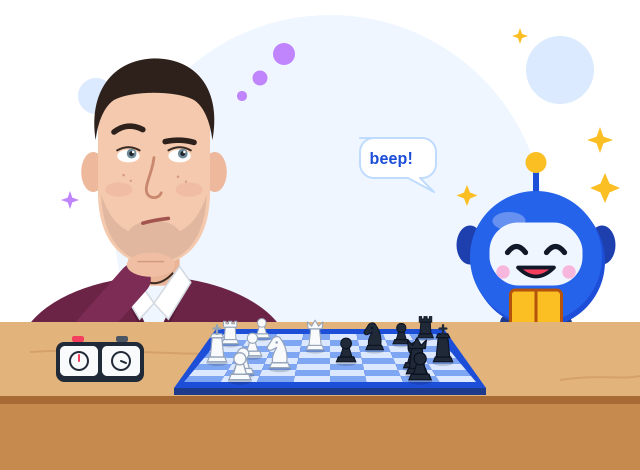
Illustration: Teddy and Bit, the course’s little robot, playing chess

How to study each lecture

Every lecture page brings the same four things together. Use them in any order; this one works well.

Watch

Start with the lecture's short animated episodes (ACML Explains), about five minutes each, with a transcript to read along. They give the intuition first.

Read the slides

Each deck is written to be read without a lecturer: worked examples, “try it” boxes, small simulations, and check-yourself questions with answers at the end.

Try it

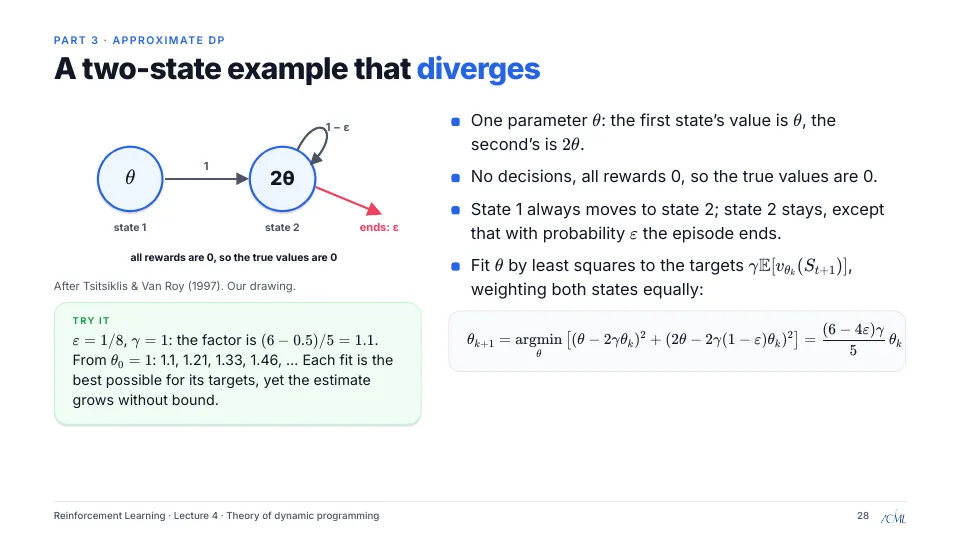
Run the algorithms yourself in the browser: 9 labs, from a bandit lab in Lecture 2 to a Bradley–Terry lab in Lecture 12.

Play

Three games turn the ideas into play: Markov’s Maze, Echo Heist and Pirates War RL. Each lecture page says which one fits and what to look for.

Twelve lectures

From an agent chasing a single number to learning from people. Each card opens the lecture page with its episodes, slides, lab and games.

The order of topics follows the DeepMind × UCL Reinforcement Learning Lecture Series (2021) and, for parts of Lectures 9 and 12, Stanford CS234 (2024). The slides, figures, examples and simulations are ACML’s own, not official DeepMind, UCL or Stanford material; each lecture page names its source.

Labs and games

Learn by doing. The labs run the algorithms from the lectures in your browser; the games put you, or an agent you build, inside a reinforcement-learning problem.

Interactive labs

Bandit lab

Pull the arms of a multi-armed bandit with ε-greedy, UCB or Thompson sampling. Change the number of arms, let the hidden reward chances drift, and watch estimates, regret and the gap to an oracle evolve.

Open it in Lecture 2

Dynamic programming lab

Watch policy evaluation, value iteration and policy iteration sweep a small gridworld. Change the discount, make moves slippery, add walls, and see the values settle and the greedy arrows lock in.

Open it in Lecture 3

Contraction lab

Start two different value functions on a small random MDP and apply the Bellman operator to both, again and again. The distance between them shrinks by at least a factor γ each time, so both end at the same fixed point.

Open it in Lecture 4

TD vs Monte Carlo lab

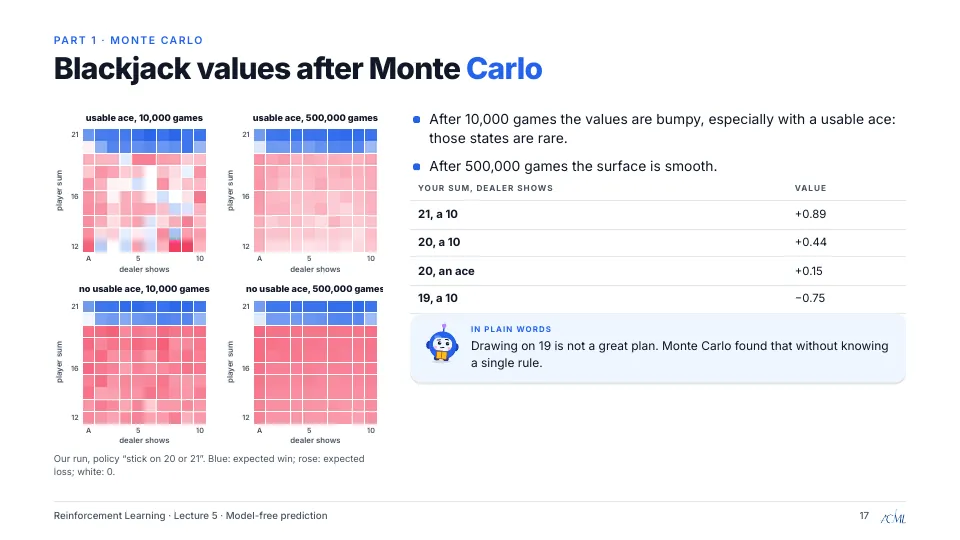
A random walk over five states, A to E. Monte Carlo and TD(0) learn from the very same episodes. Compare their estimates with the true values, and their error curves averaged over a hundred runs.

Open it in Lecture 5

Gridworld lab

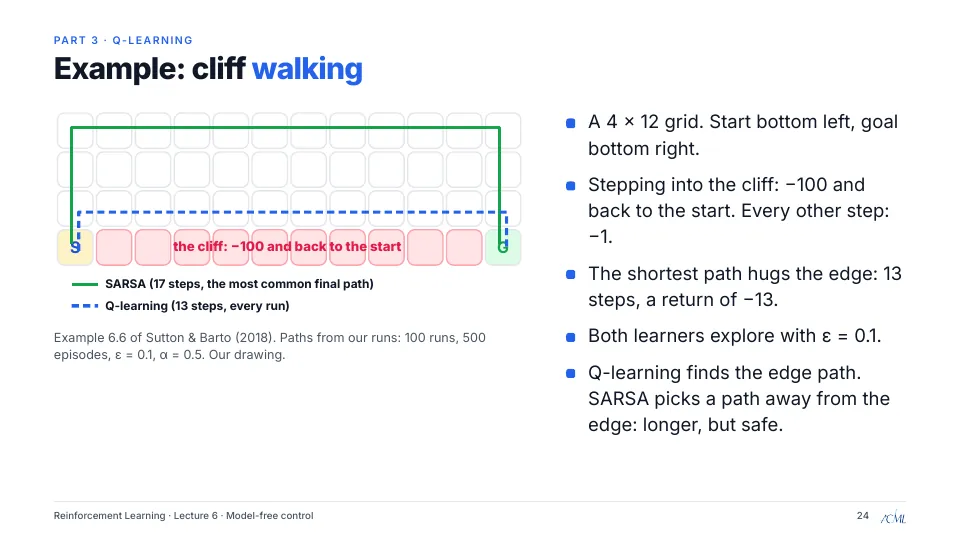
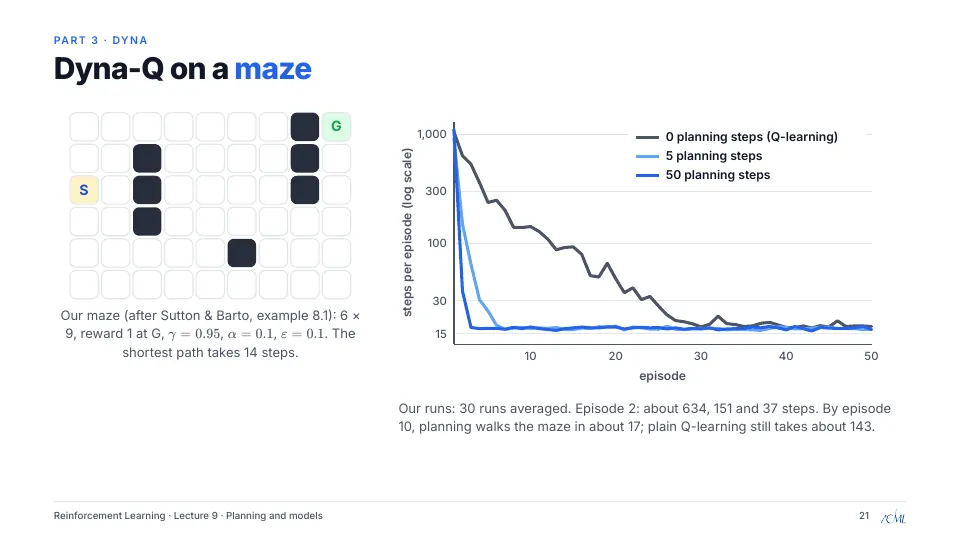
Train Q-learning or SARSA on a small gridworld with hazards and walls. Tune ε, the step size and the discount, add slippery actions, and watch the value map and the greedy policy sharpen episode by episode.

Open it in Lecture 6

Mountain Car lab

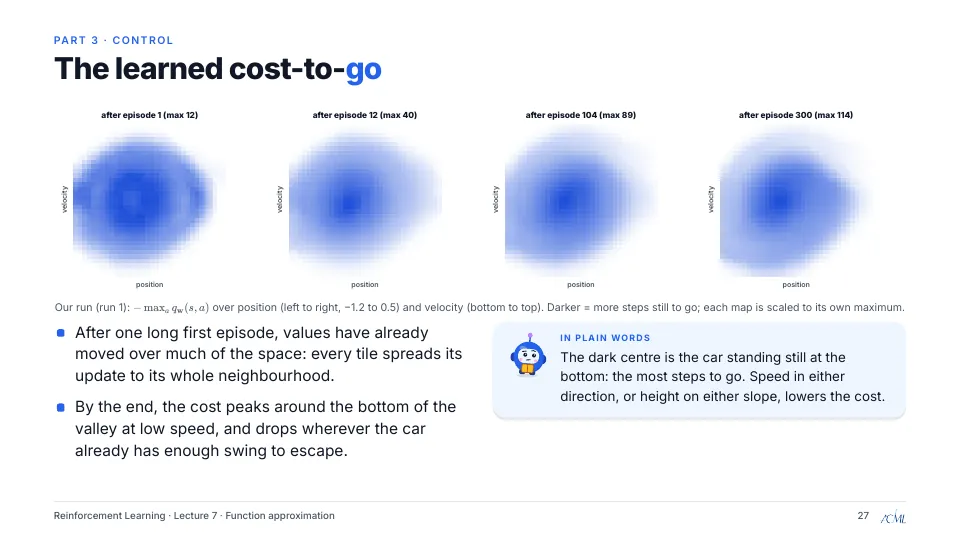
An underpowered car must rock back and forth to climb a hill. Train linear SARSA on tile-coded features, watch the steps per episode drop, look at the learned cost-to-go, and replay the greedy policy.

Open it in Lecture 7

MCTS lab

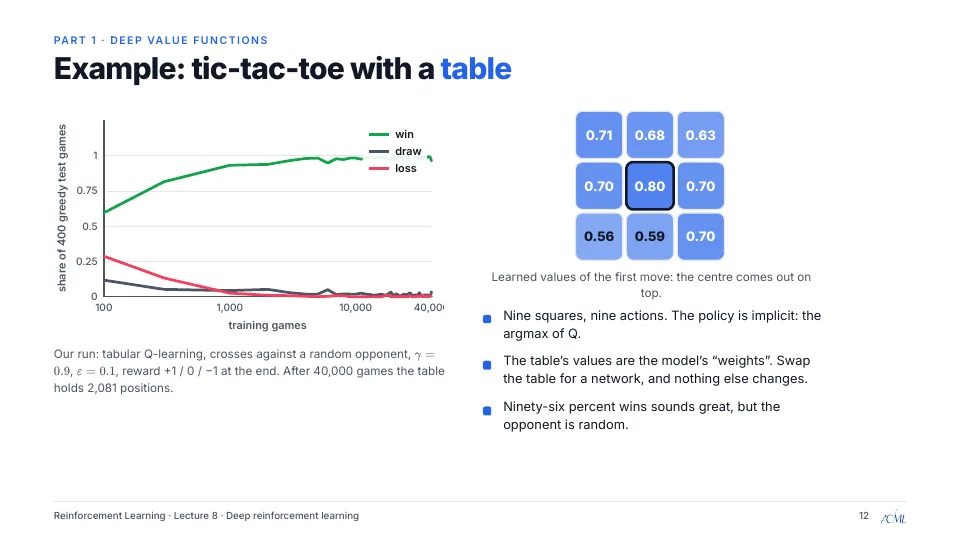
Play tic-tac-toe against Bit, who plans with Monte Carlo tree search: random play-outs, and UCB to choose which branch to try next. Change how many simulations it gets and look inside its last search.

Open it in Lecture 9

Policy-gradient bandit lab

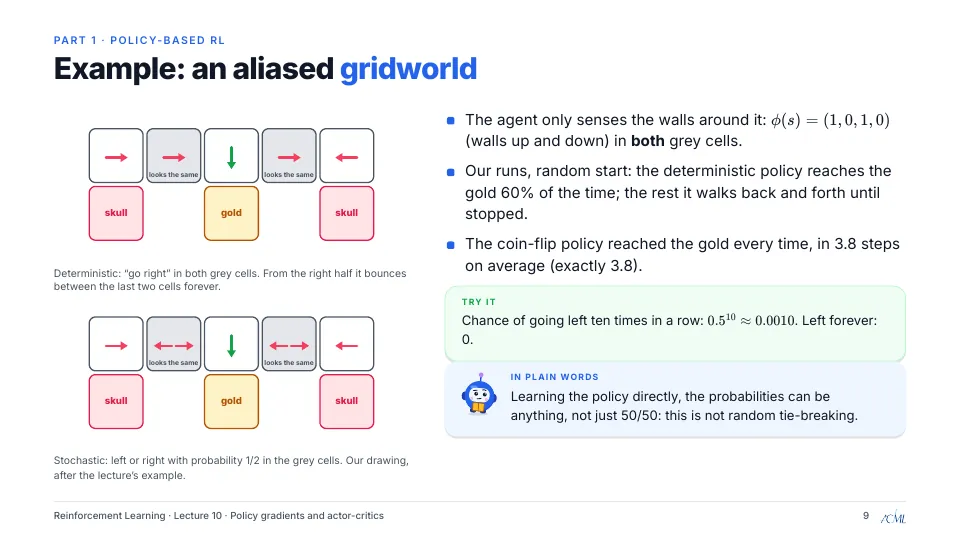
Learn a softmax policy directly with the gradient-bandit (REINFORCE) update, with or without a baseline. Shift every reward up by a constant and see why the baseline matters.

Open it in Lecture 10

Bradley–Terry lab

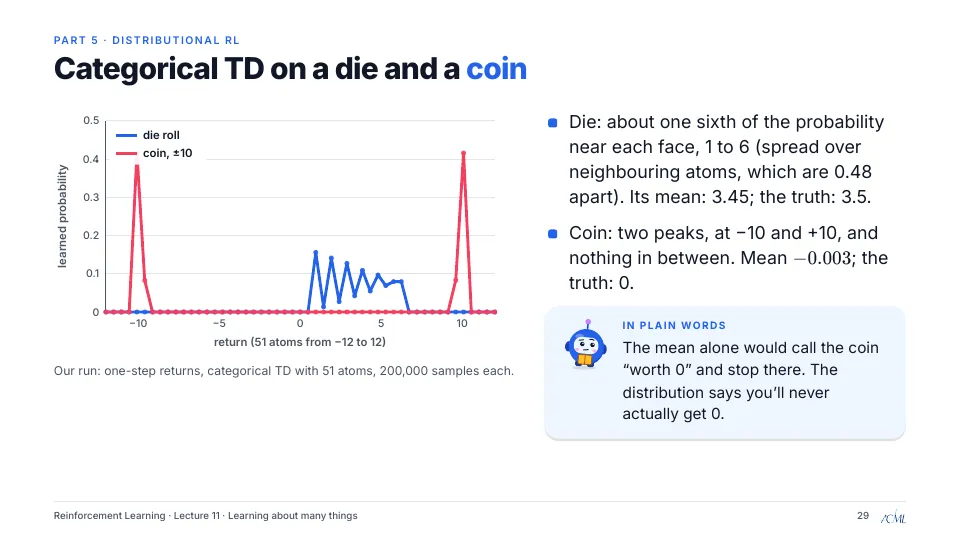
Compare answers two at a time, the way people label data for RLHF, and watch a Bradley–Terry model turn your choices into a score for each answer. Add simulated comparisons and see how many it needs.

Open it in Lecture 12

Games

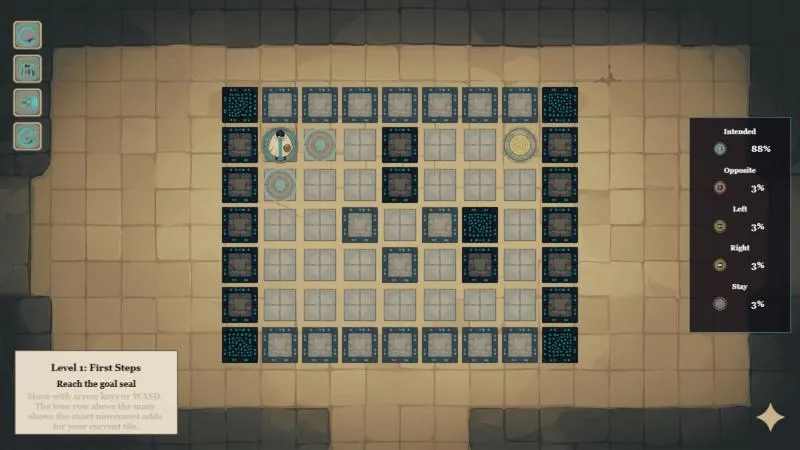
Markov’s Maze

A maze where every step is a roll of the dice.

Each rune tile resolves your move with its own five probabilities: where you meant to go, the opposite way, left, right, or stay. Reach the goal seal without falling into traps or lava, while cursed knights patrol.

Stochastic transitionsPlanning under uncertaintyMarkov decision processes

Echo Heist

Teach a little robot. Steal back a city.

Choose what your partner Echo senses, which actions it can take and what success means, then let a real learner train in your browser: tabular, planning, policy-gradient, deep-RL or imitation. When the door opens, the policy is frozen and Echo runs with what it learned.

State, actions and reward designTraining a learnerMany families of RL methods

Pirates War RL

Code your captain. Read the sea.

A naval strategy game where every decision belongs to an agent. Write your own captain in sandboxed JavaScript, Dense JSON or a restricted TensorFlow.js package, then raid, defend and capture flags against rival agents, with or without fog of war.

Writing your own agentPartial observabilityMulti-agent play