
Biomathematics
Biomathematical Modeling of Cancer and Beyond
Multi-scale tumor, immune, and therapy models built from ODEs, PDEs, and agent-based simulations.
16publications
2lab members, current and past
4collaborators and frequent co-authors
2019–2026years of papers
About the project
What this project is about
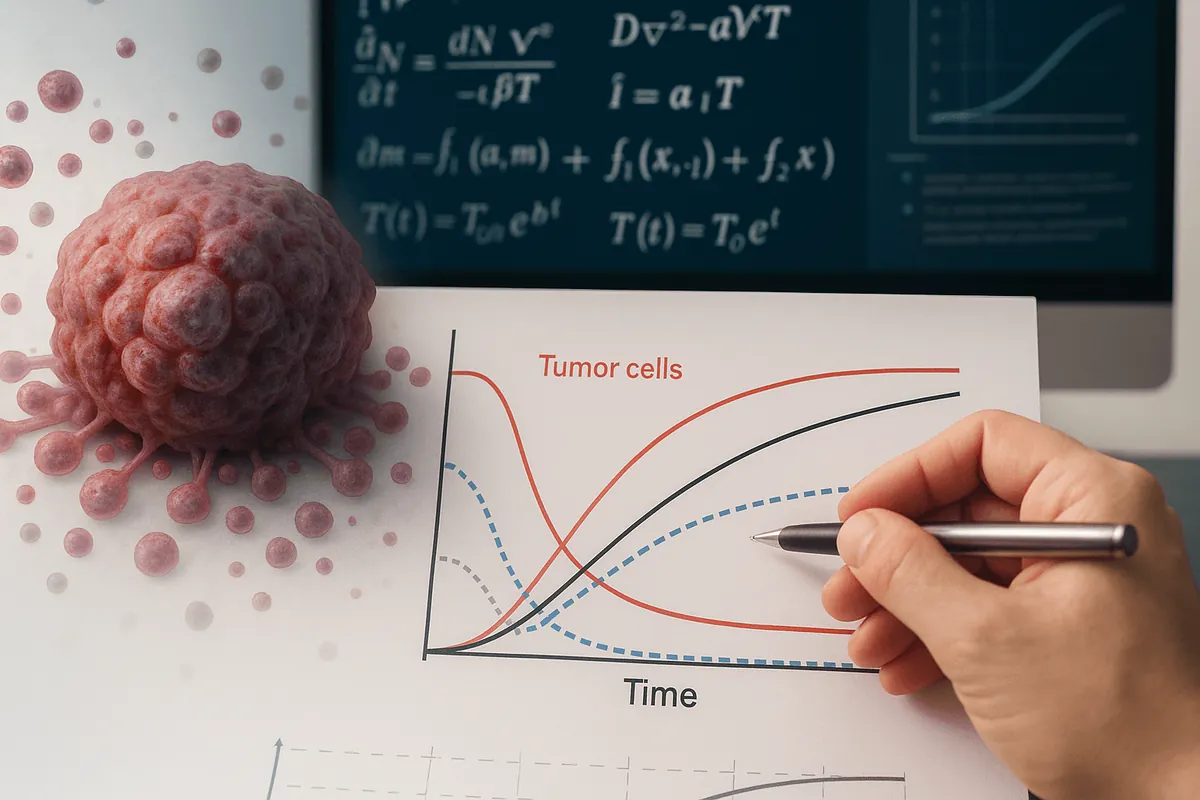
Developing bio-mathematical models for cancer spread and treatment, and for additional diseases, using ODEs, PDEs, and simulations.
This project develops mechanistic models of disease progression with a current emphasis on cancer growth, treatment scheduling, and treatment-induced senescence. The lab combines continuum models, spatial PDE systems, and agent-based simulations to reason across scales, from cellular interactions to tumor-level response. The goal is not only to fit outcomes, but to expose biological mechanisms, compare treatment schedules, and evaluate hypotheses that are difficult to test experimentally.
Approach and outcomes
The methods the project relies on and what it has produced so far.
Methods
- Nonlinear ODE and PDE systems
- Spatial tumor-growth modeling
- Agent-based simulation
- Numerical analysis
- Treatment scheduling
- Mechanistic parameter fitting
Key outcomes
- Therapy-combination models for lung and metastatic prostate cancer
- Bridges between PDE and agent-based representations of tumor geometry
- Mechanistic tools for evaluating senolytic and immunotherapy strategies
Recent results
Selected findings
A key finding from each of the project's latest papers. Every paper page has the full text, figures and a plain-language summary.
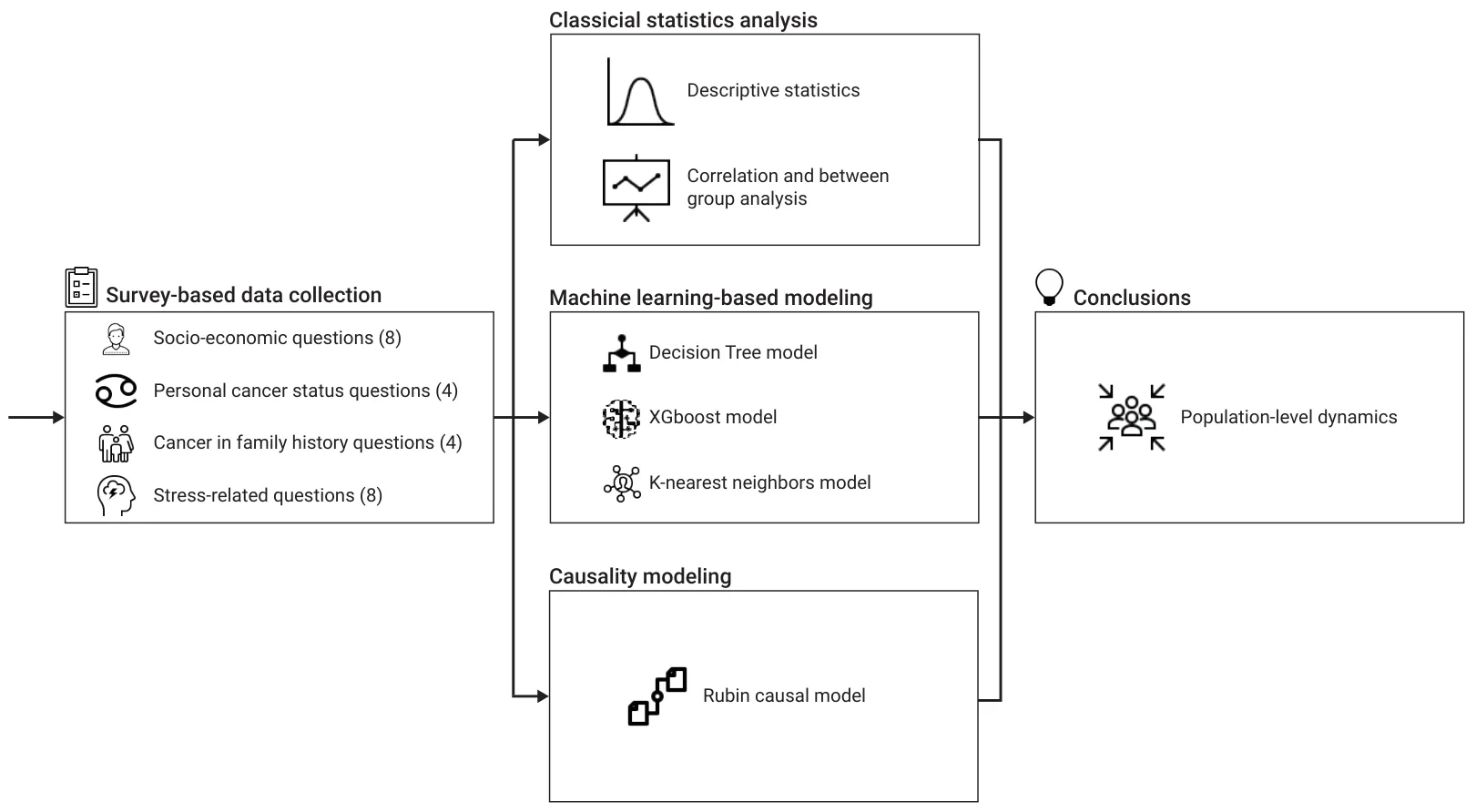
Chronic Stress, Immune Suppression, and Cancer Occurrence: Unveiling the Connection Using Survey Data and Predictive Models
Stress frequency, stress level and perceived health impact were significantly associated with cancer occurrence.
Read the paper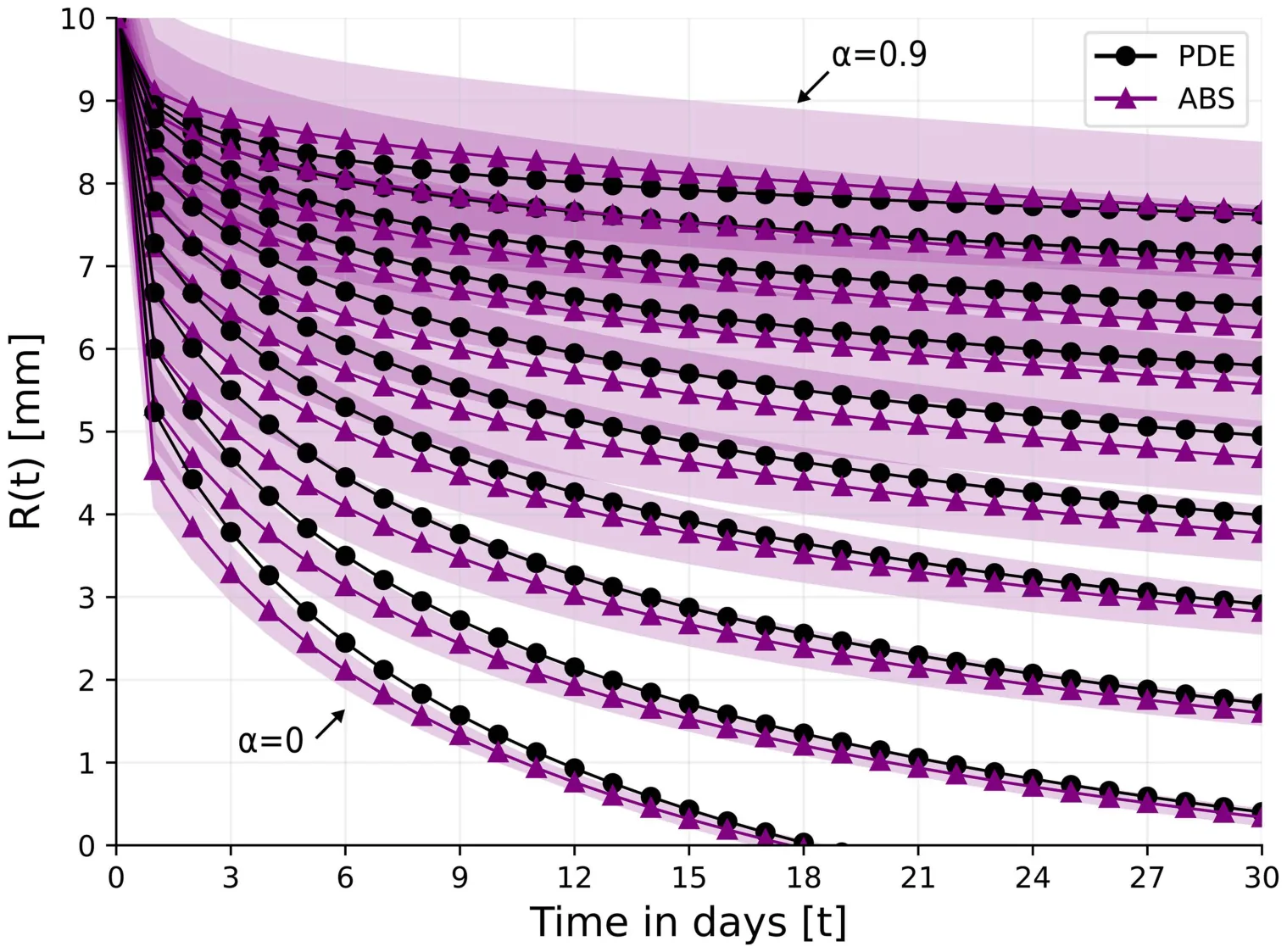
PDE and agent based simulation approaches to Ischemic Dermal Wound Closure
The partial differential equation and agent-based models produced closely agreeing profiles of the shrinking open-wound radius over time.
Read the paper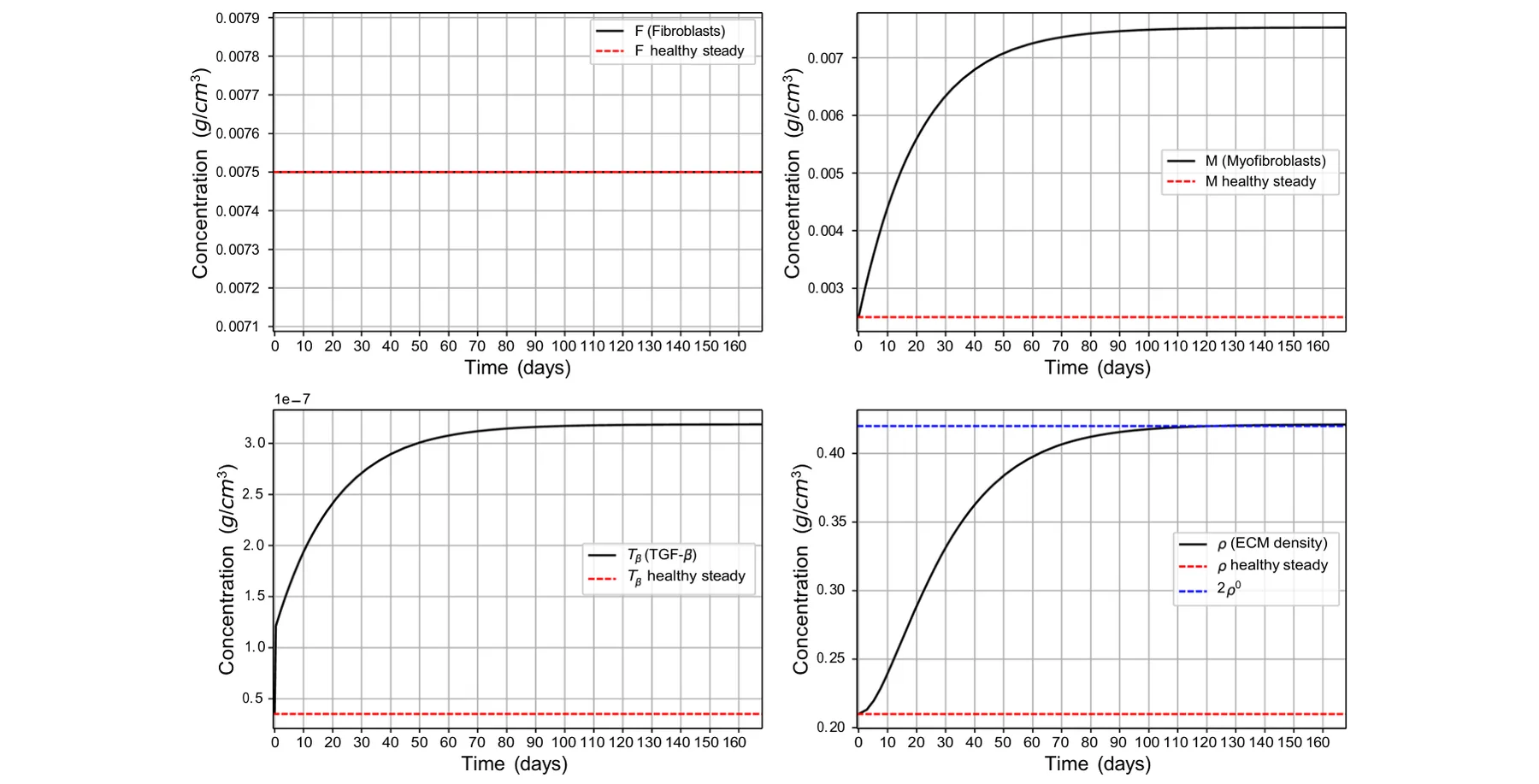
Mathematical Modeling of Systemic Sclerosis and Its Treatment
For a treatment given in fractions three weeks apart, we determined the smallest amount that makes matrix density steadily decrease from its disease level.
Read the paperPublications
Every paper from this project, newest first. Lab members are in bold; each title opens the paper's own page with the abstract, a plain-language summary and, for most papers, the full text.
16 papers
2026 3 papers
- Chronic Stress, Immune Suppression, and Cancer Occurrence: Unveiling the Connection Using Survey Data and Predictive Models
Medical Sciences · 2026Full text on the site
Chronic stress has been linked to cancer, but a direct causal connection has not been consistently established. Using self-reported survey data on stress, cancer history and demographics, we built predictive models to examine both a direct link and a possible…
- PDE and agent based simulation approaches to Ischemic Dermal Wound Closure
Plos One · 2026Full text on the site
Ischemic skin wounds, which have a reduced blood supply, are a medical challenge when they do not close in the expected time, typically 30 days. We built two very different mathematical models of flat wounds, one with partial differential equations and one…
- Mathematical Modeling of Systemic Sclerosis and Its Treatment
Bulletin of Mathematical Biology · 2026Full text on the site
Systemic sclerosis is an autoimmune disease in which cells called myofibroblasts deposit too much extracellular matrix, the material around cells, and it can spread to internal organs such as the lung. We built a mathematical model of the disease using…
2025 3 papers
- Comparing partial differential equations and agent-based simulations in spatio-temporal modeling of cancer growth and shape
Journal of Computational and Applied Mathematics · 2025Full text on the site
Mathematical models of tumors based on partial differential equations (PDEs) must make ad-hoc assumptions about how the tumor's unknown boundary behaves. We built an alternative agent-based simulation, which follows many individual interacting agents, using…
- Spatio-temporal model of combining ADT and chemotherapy with senolytic treatment in metastatic prostate cancer
Journal of Theoretical Biology · 2025Full text on the site
A standard treatment for metastatic prostate cancer is androgen deprivation, cutting off the hormone its cells depend on, followed by added chemotherapy once some cells become androgen-independent. Senescent cells, which stop dividing but stay alive, can…
- Spatio-Temporal Model of Combining Chemotherapy with Senolytic Treatment in Lung Cancer
Mathematical Biosciences · 2025Full text on the site
Chemotherapy kills cancer cells but can leave some in a senescent state, alive but no longer dividing, and in lung cancer these cells release VEGF, which triggers new blood vessel growth that helps the tumor grow. We developed a spatio-temporal mathematical…
2024 1 paper
- Predicting lung cancer's metastats' locations using bioclinical model
Frontiers in Medicine · 2024Full text on the site
Metastasis, the spread of cancer to other parts of the body, strongly affects lung cancer treatment outcomes, yet conventional imaging struggles to detect small metastases. We developed a bioclinical model that uses three-dimensional CT scans and a…
2023 3 papers
- Cancer-inspired genomics mapper model for the generation of synthetic DNA sequences with desired genomics signatures
Computers in Biology and Medicine · 2023Full text on the site
Genome data are vital to modern medicine, but obtaining suitable genomes for a specific study is hard, and current synthetic genome generators ignore the biological relations behind the patterns they copy. We propose the cancer-inspired genomics mapper model…
- Mathematical Model for the BCG-based Treatment Of Type 1 Diabetes
Physica A: Statistical Mechanics and its Applications · 2023Full text on the site
We built the first mathematical model of an immunotherapy treatment for type 1 diabetes with the BCG vaccine. Ordinary differential equations link several immune cell types and body compartments to the clinical course of the disease, and we applied the model…
- Scheduling BCG and IL-2 Injections for Bladder Cancer Immunotherapy Treatment
Mathematics · 2023Full text on the site
Bladder cancer is commonly treated with a weekly immunotherapy protocol of BCG and IL-2 injections, yet results vary widely between patients, and existing models often describe a non-existent average patient. We built the most extensive model of BCG treatment…
2022 2 papers
- Cell-level Spatio-Temporal Model for Bacillus Calmette--Guerin Based Immunotherapy Treatment Protocol of Superficial Bladder Cancer
Cells · 2022Full text on the site
Weekly BCG immunotherapy is the gold standard for superficial bladder cancer, but outcomes vary widely and existing models have large errors for long-term treatments. We built a cell-level agent-based simulation of interactions between cells and their…
- Mathematical Model for the BCG-based Treatment of Type 1 Diabetes
Dynamical Systems Applied To Biology And Natural Science · 2022
2021 1 paper
- Improved Geometric Configuration for the Bladder Cancer BCG-Based Immunotherapy Treatment Model
International Symposium on Mathematical and Computational Oncology · 2021Full text on the site
We extend an earlier model of BCG-based immunotherapy for bladder cancer, proposed by Lazebnik et al. (2021), by approximating the bladder's shape as an ellipsoid ring instead of a sphere ring. We show how the original and extended models differ in their…
2020 2 papers
- PDE based geometry model for BCG immunotherapy of bladder cancer
biosystems · 2020Full text on the site
BCG immunotherapy often succeeds against bladder cancer, but results vary widely between patients. We present a mathematical model of the treatment that uses partial differential equations to approximate the shape of the bladder. Because it accounts for where…
- PDE Modeling of Bladder Cancer Treatment Using BCG Immunotherapy
Functional Differential Equations conference · 2020
2019 1 paper
- Treatment of Bladder Cancer Using BCG Immunotherapy: PDE Modeling
Functional Differential Equations · 2019Full text on the site
BCG immunotherapy is an established treatment for superficial bladder cancer. We developed a first mathematical model that uses partial differential equations to describe how the tumor and the immune system interact in the bladder during BCG therapy, taking…
No paper matches these words.
The team
The lab members who work or worked on this project, with their part in it, and the researchers we work with. See the whole lab on the team page.
Current members 1
Past members 1


Frequent co-authors
Researchers outside the lab who co-wrote two or more of the papers above.
Videos
Short explainers of the research in this project.

Systemic Sclerosis in Silico: Why Spaced Shots Beat a Daily Pill (in Our Model)
In a model of skin scarring in systemic sclerosis, small TGF-beta-blocking shots every three weeks beat a daily cell-killing pill.
In the media
News stories, interviews and podcasts about this project's research. More on the media page.

Interested in this project?
We welcome collaborations, data partnerships and students who want to work on biomathematics problems with us.