
Scientific ML
Developing the Next Step of Physics-Inspired Symbolic Regression
Interpretable equation discovery that blends domain knowledge, modern machine learning, scientific priors, and physics-informed generative data enrichment.
12publications
8lab members, current and past
3collaborators and frequent co-authors
2022–2026years of papers

About the project
What this project is about
Advancing physics-informed symbolic regression for interpretable models discovered from data.
This project advances symbolic regression from a niche equation-search tool into a practical scientific machine-learning pipeline. The lab studies how to inject domain knowledge, distill strong black-box predictors into symbolic forms, and improve out-of-distribution robustness without sacrificing interpretability. The resulting systems are aimed at physics, engineering, and structured-data settings where researchers need both predictive performance and equations they can inspect. A newer direction uses physics-informed temporal diffusion models as a data-enrichment step: they generate synthetic trajectories that keep the governing dynamics, boundary conditions, or conservation structure, so that symbolic regression can recover compact equations even from scarce, noisy, or partially observed measurements.
Approach and outcomes
The methods the project relies on and what it has produced so far.
Methods
- Symbolic regression
- Physics-informed learning
- Knowledge integration
- Teacher-student distillation
- Genetic algorithms
- Out-of-distribution evaluation
- Diffusion models for time series
- Synthetic data generation
- Noise-robust equation discovery
Key outcomes
- Open frameworks for knowledge-aware symbolic regression
- Improved accuracy through symbolic feature engineering and distillation
- More robust equation recovery under noise, sparse data, and distribution shift
- A pipeline for generating physically plausible synthetic trajectories
- Benchmarks for measuring symbolic-regression gains from diffusion-based enrichment
Recent results
Selected findings
A key finding from each of the project's latest papers. Every paper page has the full text, figures and a plain-language summary.
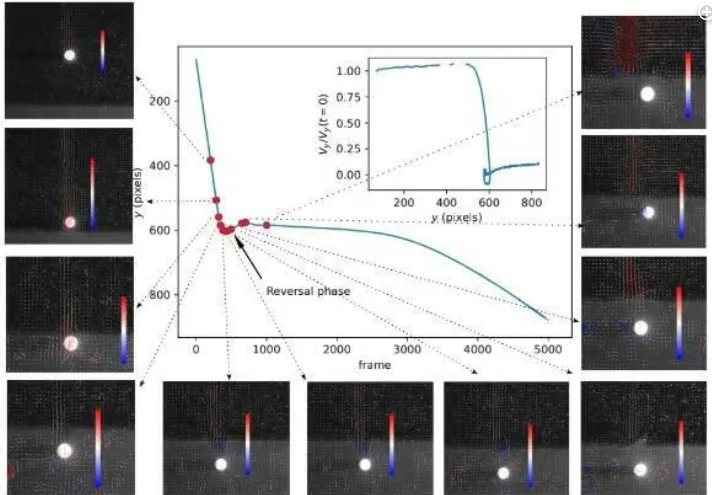
Physics-informed symbolic regression reveals a delayed oscillatory closure for particle–interface dynamics
The method produced a compact analytical formula for the delayed force on spheres crossing sharp density interfaces, replacing an auxiliary virtual-mass differential equation.
Read the paper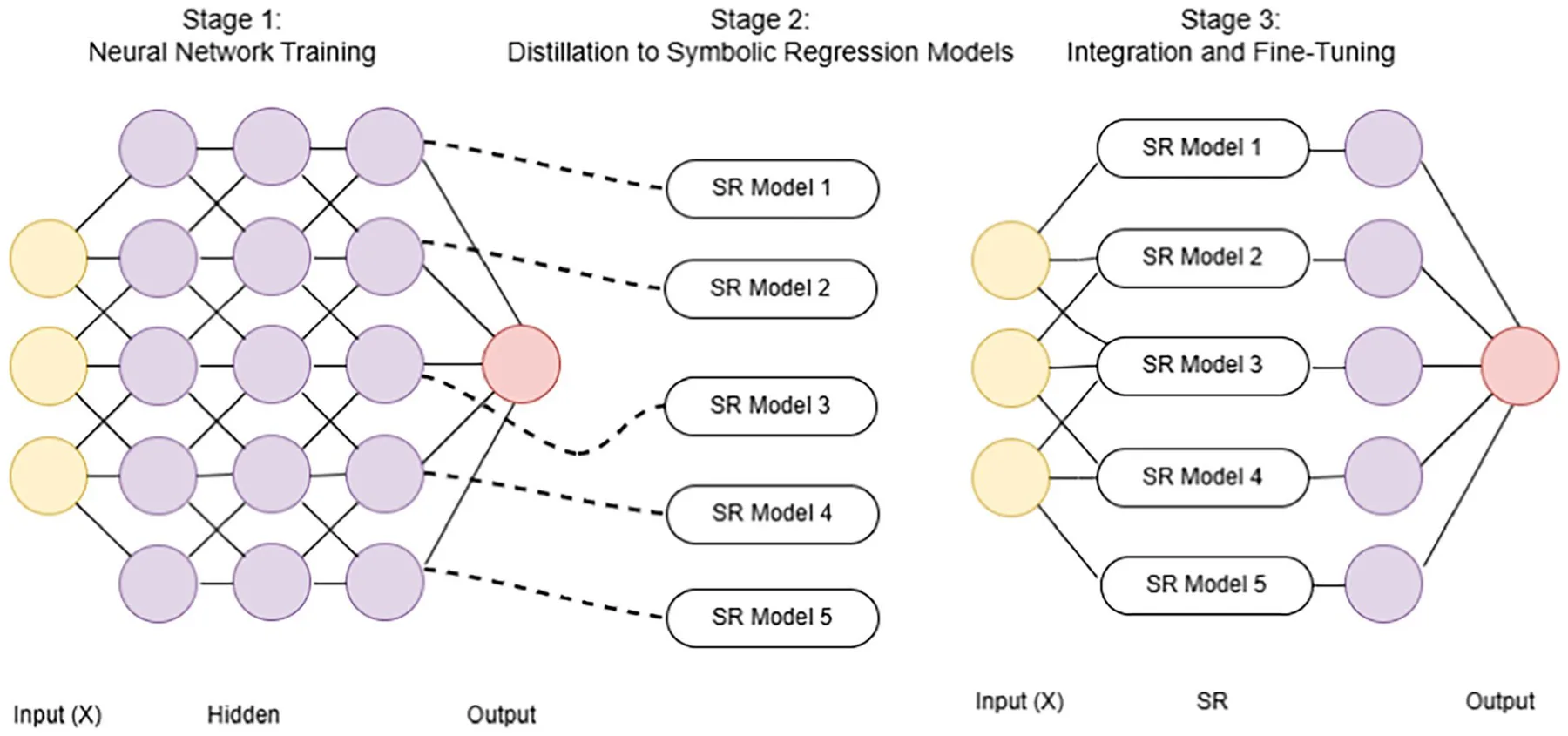
Interpretable knowledge distillation via symbolic regression for feedforward neural networks
Symbolic regression models are used to approximate the final hidden layer activations of a trained feedforward neural network.
Read the paper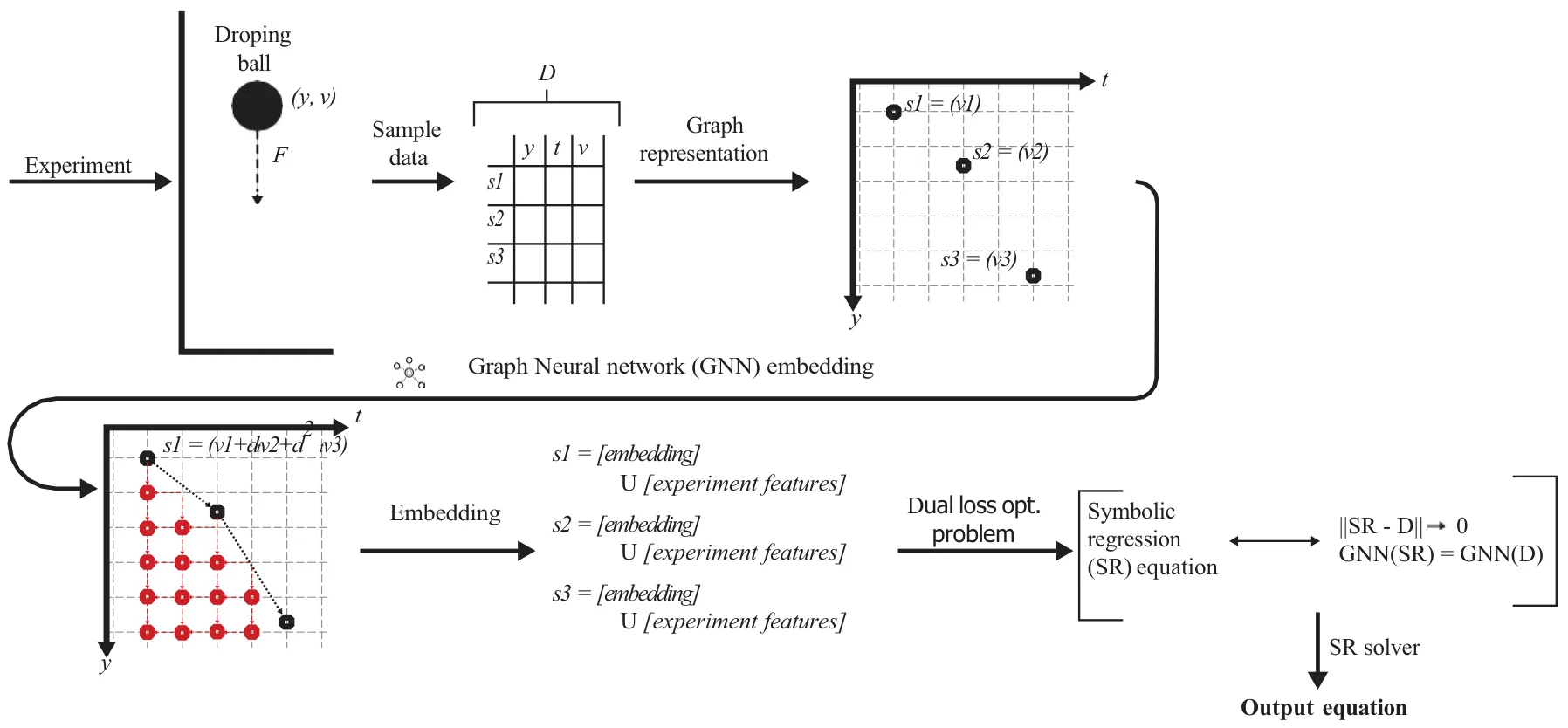
Moving from table to graph in physics-informed spatio-temporal symbolic regression
Combining a tabular and a graph-based spatio-temporal representation enhances existing symbolic regression solvers without modifying their internal search mechanism.
Read the paperPublications
Every paper from this project, newest first. Lab members are in bold; each title opens the paper's own page with the abstract, a plain-language summary and, for most papers, the full text.
12 papers
2026 5 papers
- Physics-informed symbolic regression reveals a delayed oscillatory closure for particle–interface dynamics
Machine Learning: Science and Technology · 2026Full text on the site
Particles sinking through layers of fluid with different densities can slow sharply, linger near the boundary and even appear to bounce, which classical models struggle to capture. We applied physics-informed symbolic regression, a method that searches for…
- Interpretable knowledge distillation via symbolic regression for feedforward neural networks
Neural Computing and Applications · 2026Full text on the site
Neural networks predict well but are hard to interpret, while symbolic regression produces readable mathematical formulas that are usually less accurate. We proposed a knowledge distillation method that uses symbolic regression to approximate the activations…
- Moving from table to graph in physics-informed spatio-temporal symbolic regression
Scientific Reports · 2026Full text on the site
Symbolic regression searches for mathematical formulas that describe data, but it usually treats data as a flat table and ignores how physical systems change across space and time. We paired the usual table with a graph whose nodes hold points in space and…
- Knowledge integration for physics-informed symbolic regression using pre-trained large language models
Scientific Reports · 2026Full text on the site
Physics-informed symbolic regression finds equations from data using domain knowledge, but current methods often need specialized formulations and manual feature engineering. We added a pre-trained large language model to the search's loss function, so that…
- Follow the Forest Trail: Distillation by Gradient Boosting Models to Enhance Symbolic Regression Performance
IEEE Access · 2026Full text on the site
Symbolic regression produces short, explainable formulas but is usually less accurate than models such as random forests. We proposed a two-step teacher-student approach: a gradient boosting model is trained for accuracy, and a symbolic regression model is…
2025 3 papers
- A comprehensive benchmark of machine and deep learning models on structured data for regression and classification
Neurocomputing · 2025Full text on the site
On tabular data, the table-style datasets common in research and real-world applications, deep learning models often fail to beat traditional methods such as gradient boosting machines. We benchmarked 20 models on 111 regression and classification datasets to…
- Machine and deep learning performance in out-of-distribution regressions
Machine Learning: Science and Technology · 2025Full text on the site
Machine learning models assume their training data represent the task well, and when new data fall outside that distribution, performance can drop unexpectedly. We measured this out-of-distribution drop for several machine learning, deep learning and AutoML…
- Introducing “Inside” out of distribution
International Journal of Data Science and Analytics · 2025Full text on the site
Machine learning models can fail on out-of-distribution samples, data unlike what they were trained on, but research has mostly focused on samples that fall outside the training range. We proposed dividing such cases into inside (interpolatory) and outside…
2024 3 papers
- Symbolic regression as a feature engineering method for machine and deep learning regression tasks
Machine Learning: Science and Technology · 2024Full text on the site
Machine learning models depend on good input features, which are usually hand-designed by experts or hidden inside neural networks where they are hard to interpret. We propose using symbolic regression, which searches for explicit mathematical formulas, to…
- Knowledge-integrated autoencoder model
Expert Systems with Applications · 2024Full text on the site
Autoencoders are neural networks that compress data into a compact representation, but developers have little control over what that representation captures. We introduce the Knowledge-integrated AutoEncoder (KiAE), which brings external domain knowledge into…
- Improved prediction of settling behavior of solid particles through machine learning analysis of experimental retention time data
International Journal of Multiphase Flow · 2024Full text on the site
Particles often sink through layers of fluid with different densities, in nature and in engineering, but how they interact with these layers is not well understood. We ran a simplified settling experiment with a large number of particles and applied machine…
2022 1 paper
- A computational framework for physics-informed symbolic regression with straightforward integration of domain knowledge
Scientific Reports · 2022Full text on the site
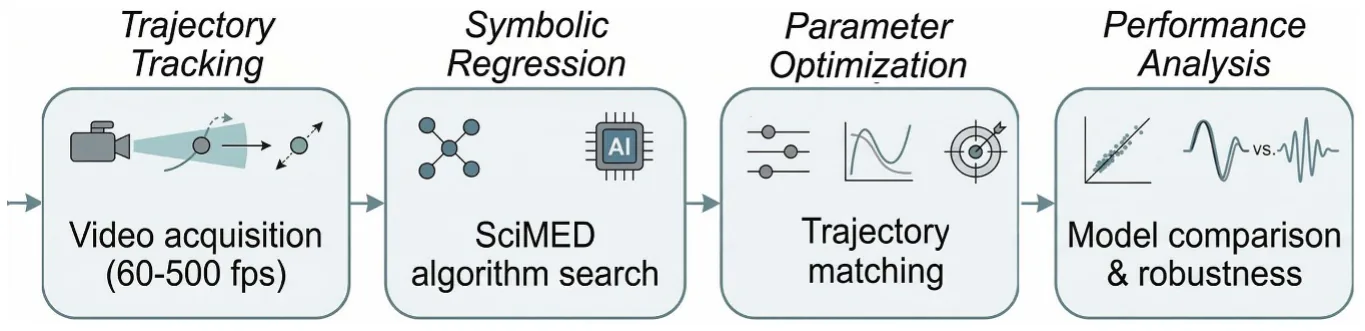
Finding a mathematical formula that explains experimental data, a task called symbolic regression, is a core challenge in many sciences. We present SciMED, an open-source framework that brings a scientist's domain knowledge into the loop and combines genetic…
No paper matches these words.
The team
The lab members who work or worked on this project, with their part in it, and the researchers we work with. See the whole lab on the team page.
Current members 2

Past members 6





Tamas Kristof Toth
MSc (alumni) · Dec 2025 – Jun 2026
Physics-informed diffusion models for enriching symbolic-regression data

Wenxiong Xie
MSc (alumni) · Jan 2025 – Jul 2025
Adding domain knowledge to physical symbolic regression with pre-trained large language models
1 paper in this project

Frequent co-authors
Researchers outside the lab who co-wrote two or more of the papers above.
Videos
Short explainers of the research in this project.

A Ball That Bounces Back Up Underwater? AI Found the Missing Force
A ball sinking through two layered liquids can drift back up at the boundary. Physics-informed AI found the missing force: a delayed kick that fades as it wobbles.

Symbolic Distillation in Neural Networks
Opening the black box: distilling a trained neural network into equations people can read.
In the media
News stories, interviews and podcasts about this project's research. More on the media page.


Interested in this project?
We welcome collaborations, data partnerships and students who want to work on scientific ml problems with us.