
Machine Learning
Machine-Learning Methods and Applications
New algorithms that make machine learning more accurate, explainable and robust, and their use on problems from wildfires to language and family life.
18publications
4lab members, current and past
2collaborators and frequent co-authors
2022–2026years of papers

About the project
What this project is about
Developing machine-learning methods for feature selection, AutoML, optimization and anomaly detection, and applying machine learning to climate, language and social questions.
This project gathers the lab's work on machine-learning methods and on applying them to new problems. On the methods side, we develop algorithms that make models more accurate, explainable and reliable: FSPL tunes filter and embedded feature selection together as one pipeline and was tested on 90 datasets; OFEE builds feature ensembles that balance explainability and performance; a definition of feature-selection stability inspired by Lyapunov stability captures resilience to data drift; SAT-PP prunes decision trees with Boolean satisfiability while keeping their accuracy; SubStrat speeds up existing AutoML tools by searching on a small, representative subset of the data; and FAME, an optimizer based on a triple exponential moving average, was tested across 22 deep-learning architectures. We also study data that does not stay still: a genetic-algorithm ensemble that keeps learning under concept drift, a convex hull volume method for spotting out-of-distribution samples, Learning via Surprisability for anomalies along timelines, and a benchmark of 12 anomaly detection methods on temporal social-media graphs. On the applications side, machine learning lets us predict lightning-ignited wildfires worldwide and show that climate change has raised their risk, tailor fire weather indices to each country, analyse how audiences react to climate change videos, tell which large language model wrote a text, help writers correct the functional style of Russian texts, and ask whether the shape of a family tree predicts how satisfied relatives are with one another. Along the way, a more accurate algorithm for stiff matrix exponentials uses a learned decision tree to pick the right method for each matrix, and a vision-based learning model shows how collision-free collective motion can emerge in locust swarms.
Approach and outcomes
The methods the project relies on and what it has produced so far.
Methods
- Feature selection and meta-learning
- Automated machine learning (AutoML) and genetic algorithms
- Explainable AI
- Anomaly and out-of-distribution detection
- Concept-drift detection and ensemble learning
- Deep-learning optimizers
- Graph machine learning (variational graph autoencoders)
- Natural language processing and text classification
- Numerical linear algebra
Key outcomes
- FSPL, a meta-learning approach that finds the best filter and embedded feature selection pipeline, tested on 90 datasets (International Journal of Applied Mathematics and Computer Science, 2023)
- SubStrat, a subset-based strategy that shortens AutoML runs on large datasets (Proceedings of the VLDB Endowment, 2023)
- FAME, a triple-exponential-moving-average optimizer evaluated on 22 deep-learning architectures (Machine Learning, 2026)
- A convex hull volume-based anomaly detection method that performed comparably to state-of-the-art techniques on ten datasets (International Journal of Data Science and Analytics, 2025)
- Global explainable models of lightning-ignited wildfires showing that climate change has steadily raised their risk (Scientific Reports, 2025)
- Country-specific fire weather indices: a decision tree per country reached an ROC AUC of 0.86, against 0.69 for the best standard index (npj Natural Hazards, 2025)
- Attribution of texts to GPT-3.5, GPT-4 or Bard with 88% accuracy from linguistic features (Mathematics, 2026)
Recent results
Selected findings
A key finding from each of the project's latest papers. Every paper page has the full text, figures and a plain-language summary.
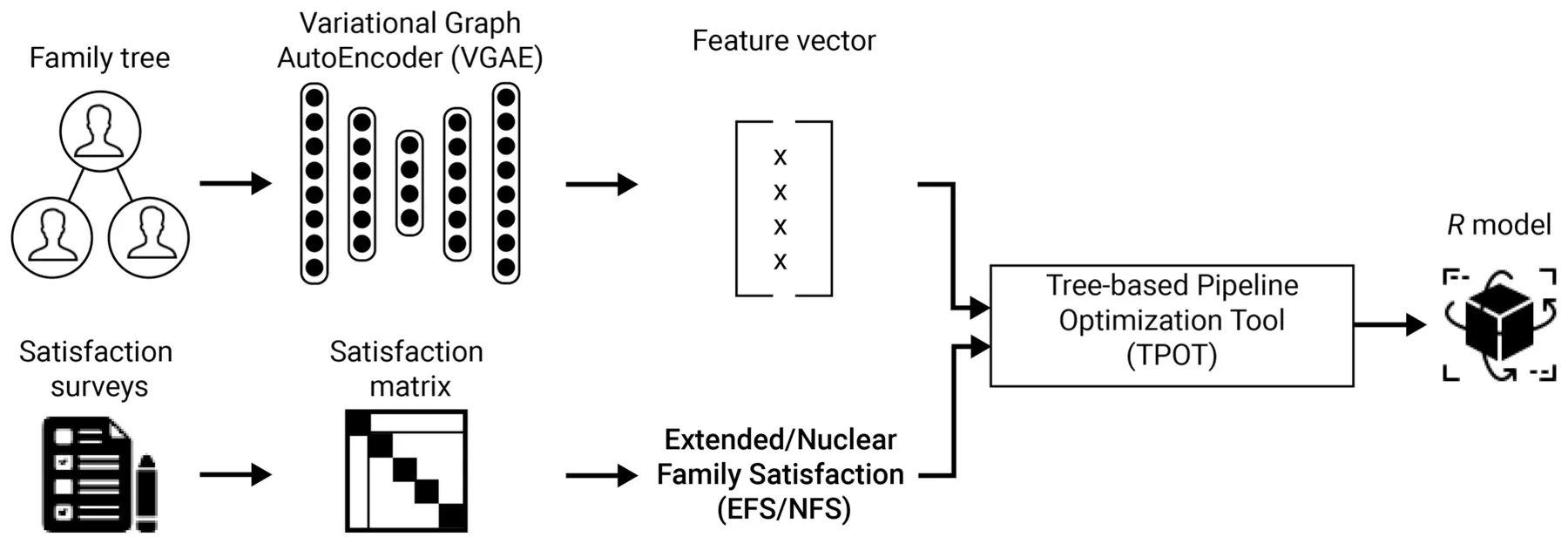
The topology of a family tree graph and its members’ satisfaction with one another: a machine learning approach
A topology-only representation of family trees showed predictive performance for reported extended and nuclear family satisfaction.
Read the paper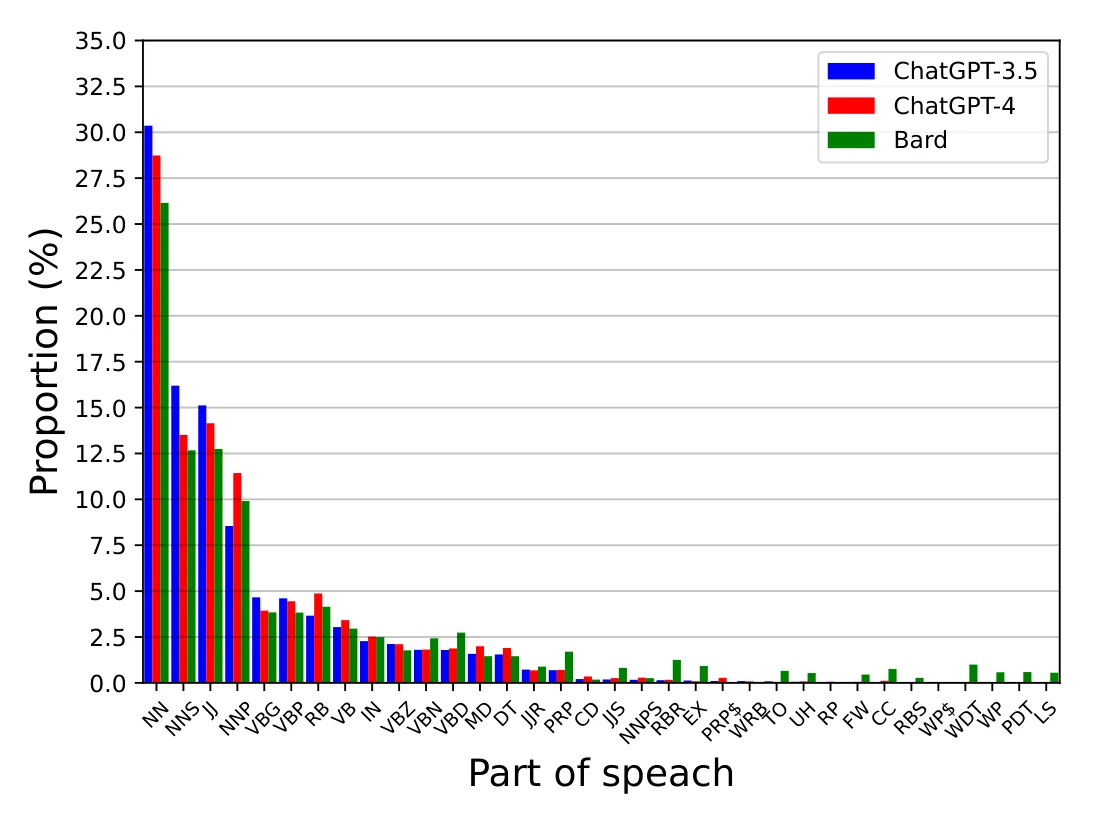
Whose LLM Is It Anyway? Linguistic Comparison and LLM Attribution for GPT-3.5, GPT-4 and Bard
Texts from GPT-3.5, GPT-4 and Bard showed significant differences in vocabulary, part-of-speech distribution, dependency distribution and sentiment.
Read the paper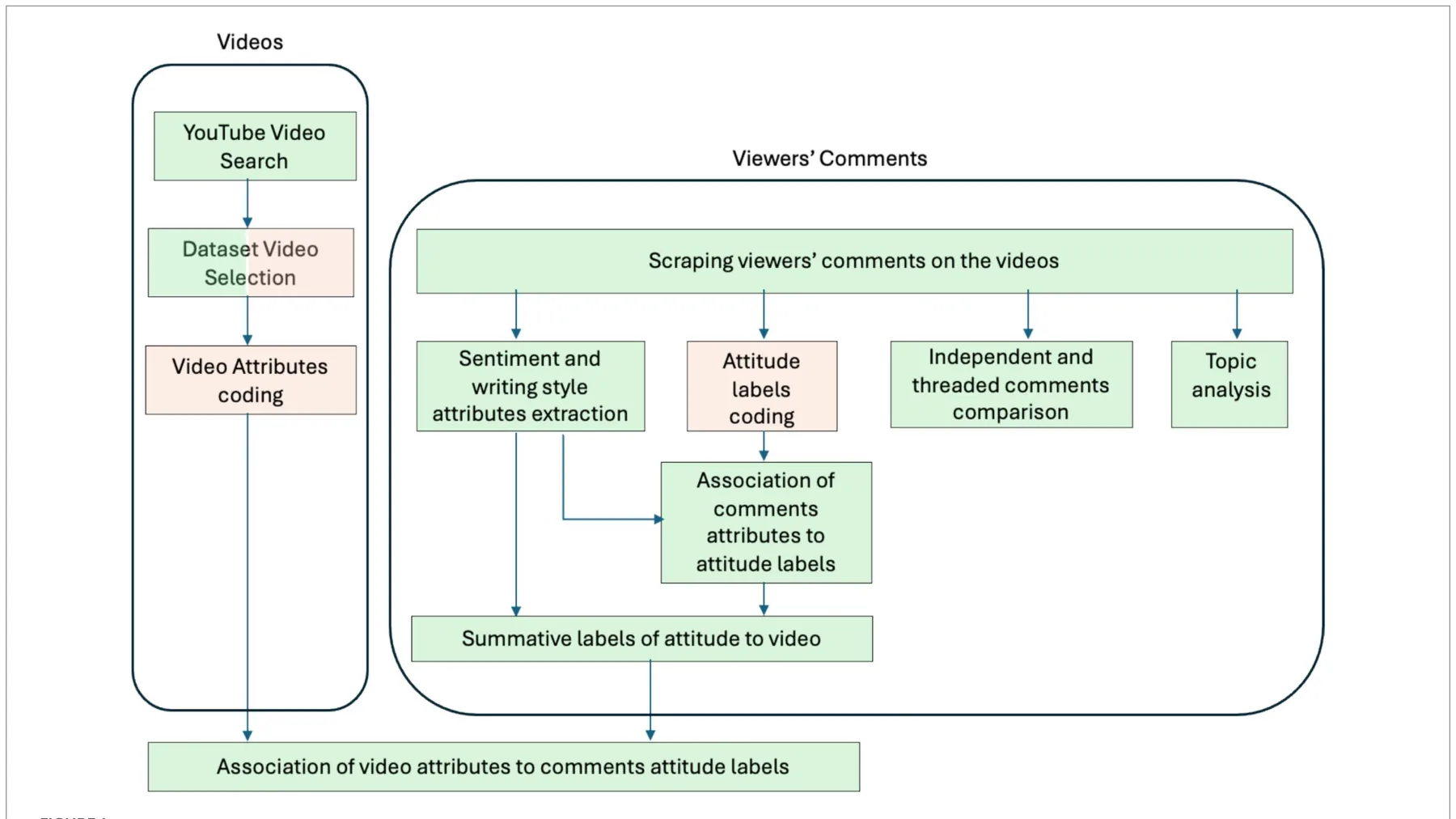
Audience engagement with climate change content on YouTube: an analysis of video attributes and user interactions
Videos presented by scientists were significantly more likely to elicit positive audience attitudes than those presented by politicians or other public figures.
Read the paperPublications
Every paper from this project, newest first. Lab members are in bold; each title opens the paper's own page with the abstract, a plain-language summary and, for most papers, the full text.
18 papers
2026 4 papers
- The topology of a family tree graph and its members’ satisfaction with one another: a machine learning approach
Frontiers in Human Dynamics · 2026Full text on the site
We asked whether the shape of a family tree, meaning who is related to whom, holds information about how satisfied family members are with one another. Each family was represented as a graph of members and relationships, compressed with a Variational Graph…
- Whose LLM Is It Anyway? Linguistic Comparison and LLM Attribution for GPT-3.5, GPT-4 and Bard
Mathematics · 2026Full text on the site
Large language models can write text that matches or surpasses human quality, but do they have recognizable styles, as human authors do? We compared the vocabulary, parts of speech, sentence structure and sentiment of texts that GPT-3.5, GPT-4 and Bard…
- Audience engagement with climate change content on YouTube: an analysis of video attributes and user interactions
Frontiers in Climate · 2026Full text on the site
We studied how the presenter, the framing of the message and the structure of comment discussions shape audience reactions to climate change videos on YouTube. We analysed 129 English-language videos and their comments, combining manual coding of the videos…
- Break a Lag: Triple Exponential Moving Average for Enhanced Optimization
Machine Learning · 2026Full text on the site
Many optimizers that train deep learning models track gradient trends with a first-order exponential moving average, which lags behind the trend and leads to suboptimal convergence. We introduced FAME (Fast Adaptive Moment Estimation), an optimizer based on a…
2025 5 papers
- Tighten the lasso: a convex hull volume-based anomaly detection method
International Journal of Data Science and Analytics · 2025Full text on the site
Spotting out-of-distribution data, samples unlike those a model was built on, is critical for keeping machine learning models reliable. We propose an anomaly detection algorithm based on the convex hull, the smallest shape that encloses a dataset: it removes…
- Pulling the carpet below the learner’s feet: Genetic algorithm to learn ensemble machine learning model during concept drift
Engineering Applications of Artificial Intelligence · 2025Full text on the site
Machine learning models used in changing environments face concept drift, where the patterns in the data shift over time. We propose a two-level ensemble built with a genetic algorithm: a global model with a drift detector aggregates a population of machine…
- Interpretable transformation and analysis of timelines through learning via surprisability
Chaos · 2025Full text on the site
Conventional techniques struggle to find outliers and trends in high-dimensional timeline data because of its complexity and sparsity. Inspired by surprisability, the cognitive science idea that people instinctively focus on unexpected deviations, we propose…
- Global lightning-ignited wildfires prediction and climate change projections based on explainable machine learning models
Scientific Reports · 2025Full text on the site
Lightning-ignited wildfires are less frequent than human-caused ones but account for the majority of burned areas in some regions, and existing prediction models are usually region-specific. We built global machine learning models that tell lightning-ignited…
- Fire weather indices tailored to regional patterns outperform global models
NPJ natural hazards · 2025Full text on the site
Fire weather indices estimate wildfire risk but are usually designed for specific regions. We built country-specific indices and found that, of three widely used indices, the Canadian one performed best, with an ROC AUC (a standard accuracy measure where…
2024 4 papers
- More Numerically Accurate Algorithm for Stiff Matrix Exponential
Mathematics · 2024Full text on the site
We propose a new, highly accurate numerical algorithm for computing matrix exponentials, built by approximating Putzer's algorithm through analytically solving and approximating its coefficients. It outperforms other matrix exponential algorithms for stiff…
- An algorithm to optimize explainability using feature ensembles
Applied Intelligence · 2024Full text on the site
Feature ensembles help find the set of input variables that gives the best predictive accuracy, but existing methods ignore how explainable the resulting model is. We present OFEE (Optimizing Feature Ensembles for Explainability), a parameter-free algorithm…
- Temporal graphs anomaly emergence detection: benchmarking for social media interactions
Applied Intelligence · 2024Full text on the site
Temporal graphs capture how interactions between many agents change over time, and detecting anomalies in them matters for spotting emerging trends, network security, disease outbreaks and financial dynamics. We benchmarked 12 data-driven anomaly detection…
- A new definition for feature selection stability analysis
Annals of Mathematics and Artificial Intelligence · 2024Full text on the site
Feature selection stability, whether a method keeps choosing the same input variables, helps build reliable machine learning models that are less prone to overfitting and adversarial attacks. We show that existing stability metrics miss key aspects of many…
2023 4 papers
- Collective evolution learning model for vision-based collective motion with collision avoidance
Plos One · 2023Full text on the site
Animal groups such as fish schools, bird flocks and locust swarms move together while avoiding collisions, guided by senses such as vision. We propose a vision-based model in which each agent learns, by trial and error over many attempts, to move with its…
- Decision tree post-pruning without loss of accuracy using the SAT-PP algorithm with an empirical evaluation on clinical data
Data & Knowledge Engineering · 2023Full text on the site
Decision trees are popular, easy-to-explain prediction models, especially in medicine, but they can grow large, become hard to understand and misclassify new data. We propose SAT-PP, a pruning algorithm based on Boolean satisfiability (a logic-solving…
- SubStrat: A Subset-Based Optimization Strategy for Faster AutoML
VLDP · 2023Full text on the site
Automated machine learning (AutoML) tools search millions of possible model pipelines, but on large datasets they take increasingly long to run. We present SubStrat, which wraps existing AutoML tools and uses a genetic-based algorithm to find a small but…
- FSPL: A Meta-Learning Approach for a Filter and Embedded Feature Selection Pipeline
International Journal of Applied Mathematics and Computer Science · 2023Full text on the site
Machine learning models often work better when only the most useful input variables are kept, a step called feature selection. We argue that two common kinds, filter and embedded feature selection, should be tuned together as one pipeline, and we propose…
2022 1 paper
- Computer aided functional style identifcation and correction in modern Russian texts
Journal of Data, Information and Management · 2022Full text on the site
Functional style describes which set of linguistic norms a text follows, such as artistic or academic writing. We trained a deep learning attention neural network to sort modern Russian texts into four functional styles, reaching 0.72 accuracy, and used it to…
No paper matches these words.
The team
The lab members who work or worked on this project, with their part in it, and the researchers we work with. See the whole lab on the team page.
Current members 2

Past members 2


Frequent co-authors
Researchers outside the lab who co-wrote three or more of the papers above.
Videos
Short explainers of the research in this project.

Pick feature selection methods together, not one at a time
Often two feature selection methods run in a row, a filter and then an embedded method, and we argue they should be chosen together. FSPL learns from past datasets which pipeline suits a new one, searching with a genetic algorithm. On 90 classification datasets with 24 possible pipelines, no single pipeline was best everywhere; FSPL picked the best one for about half of the datasets and improved accuracy by up to 5.98% over the next best meta-learning method.

Make AutoML 76% faster by using less data
AutoML tools search among millions of pipelines, and every try is slower on big data. SubStrat shrinks the data instead: a genetic algorithm finds a small subset that keeps the full data's entropy, the AutoML tool runs on it, and a short run on the full data fine-tunes the result. Across 18 datasets and three AutoML tools it cut computation time by 76.3% on average while keeping 95.85% of the best model's accuracy.

Prune a decision tree without losing accuracy
Pruning shrinks a decision tree but usually costs accuracy, which in medicine may be unacceptable. SAT-PP turns the tree's paths into Boolean satisfiability constraints and simplifies them one outcome class at a time, keeping the unpruned tree's accuracy. On breast, lung and cervical cancer datasets, accuracy and F1 score matched the unpruned trees exactly while query time fell by 6.8% on average. Three small datasets, and for random forests the speed-up wasn't significant.

How does a locust swarm move without crashing?
In our simulation each agent sees only its surroundings and learns how to move over generations, adding to the group's shared knowledge. In a swarm of 30 locusts moving on the ground, the learned swarm moved together almost as well as a model trained only to flock (0.70 vs 0.75) but avoided collisions far better (0.74, against 0.17 for the flock-only model). Even hundreds of simple rules captured only 93% of the behaviour. A flat, two-dimensional simulation.

Can a model be both accurate and easy to explain?
Feature ensembles combine many feature selection runs, but existing algorithms don't treat explainability as a key factor. OFEE intersects feature sets to balance explainability and performance, with no parameters to tune. Measuring explainability by how small and how stable the feature set is, across nine canonical datasets it beat other feature selection algorithms on average by more than 8% on size and more than 7% on stability. Nine datasets, and two of many possible ways to measure explainability.

If your data shifts, will your model pick the same features?
Stable feature selection means more reliable models, clearer explanations and less exposure to attacks, but common stability definitions miss resilience to data drift and unevenly missing values. We proposed a new definition inspired by Lyapunov stability: small changes to the data should cause only small changes to the selected features. Across 90 datasets it was statistically different from the classic record-stability measure, and we describe three scenarios, each best suited to one of three measures. There's no single best measure.

A more accurate matrix exponential for stiff problems
The matrix exponential solves systems of linear differential equations, and stiff matrices make it hard to compute accurately. Our algorithm builds on Putzer's method, solving its coefficient equations analytically and then approximating them. On seven kinds of stiff matrices from 3×3 to 1000×1000 it was more accurate than other algorithms at several sizes, with costs growing at about the same rate. A decision tree, built with machine learning and genetic programming, picks an efficient algorithm for each matrix, since no single algorithm wins everywhere.

Can an algorithm spot trouble brewing on social media?
A temporal graph records who interacts with whom, and when, and catching anomalies as they emerge could flag trends, threats, outbreaks or financial shifts. We put twelve data-driven anomaly detection methods to the same test on two temporal graphs, from Twitter and Facebook, looking for unusual group interactions. The pattern was unclear: no method was reliably best, which shows the field needs new approaches for networks that never stand still. Two platforms, and a benchmark of existing methods.

What happens when the ground shifts under an AI model?
When the world changes, the patterns a model learned can drift away. Instead of one model watching for drift, we built a two-level ensemble: a population of models, each with its own drift detector, under a global model, evolved by a genetic algorithm and improved with AutoML. On synthetic datasets it significantly outperformed a single model with drift detection, especially for unknown or mixed drift, and declined only sub-linearly as drift sped up. Real-world drift may differ.

Tighten the lasso: finding outliers with a convex hull
Wrap the data in a convex hull, like a rubber band around every point: outliers stretch it, so removing one shrinks the hull's volume far more than removing a typical point. Our method peels off points until the volume stops changing much. Against seven widely used anomaly detection methods on ten datasets it performed comparably to the state of the art, and a quick test tells in advance which datasets suit it. It struggles with ring-shaped data and is heavy to compute.

What would a computer notice if it paid attention like us?
Inspired by surprisability, our instinct to focus on the unexpected, Learning via Surprisability transforms long, high-dimensional timelines by measuring how far each moment deviates from expected behavior. On sensor data with cyber attacks it had the highest AUC (82.3%, against 54.5% for Isolation Forest); on 30 years of causes of death it showed HIV deaths peaking in 2004–2005; and it traced words across 233 State of the Union addresses. Results stay interpretable, though another method had a higher F1 on the sensor data.

FAME: a neural network optimizer that breaks the lag
Popular optimizers smooth the noisy gradient with a moving average, which notices changes in trend late. FAME (Fast Adaptive Moment Estimation) uses a triple exponential moving average, which tracks trends with less lag. Tested on 22 architectures, from small convolutional networks to vision transformers, on classification, detection and segmentation, it gave the best results in 88.46% of the models' experiments and needed 23.7% fewer training epochs, at about 3% more memory and computation per epoch. Computer vision tasks only.

Can AI hear the style of a text?
A Russian language model with an attention layer, trained on 578 texts whose three expert votes all agreed, told business, academic, journalistic and literary writing apart 72% of the time. Its red highlights helped experts fix texts in the wrong style about a third faster and lifted non-experts' correct fixes from 67% to 78%. It is still wrong on about one text in four, so it points and you decide.

Can you tell which chatbot wrote this?
We gave GPT-3.5, GPT-4 and Bard the same 5,000 questions and compared the 15,000 answers on length, vocabulary, parts of speech and sentence structure. Each model had its own habits: Bard tended to write shorter answers with more personal pronouns, and GPT-3.5 used the most nouns. A simple classifier on these features named the source 88% of the time, against 33% for guessing, but tone gave nothing away: all three were positive in about 53% of answers. English only, single questions with no chat history, and the models have changed since.

Can the Shape of Your Family Tree Predict How Relatives Feel?
From the shape of a family tree alone, a graph AI predicted how satisfied relatives are with each other, off by about 0.3 points on a 10-point scale for close family.

Can we predict which lightning strikes start a wildfire?
Lightning fires are rarer than human-caused fires but add substantial carbon emissions and account for most of the burned area in some regions. Our global models separate the two and estimate the chance that lightning ignites a fire from weather and vegetation; XGBoost reached 91.6% accuracy and held up on a year it never saw, with rain on the day mattering most. Each fire type needs its own model, and from 2014 to 2021 the global risk of lightning-sparked fires rose by about 1% a year.

Can One Fire-Danger Formula Work for the Whole Planet?
We tested the three classic fire-danger formulas on over 7 million wildfires in 160 countries. Rules tuned to each region beat one formula for the whole planet.

What makes viewers side with a climate video?
We analysed 129 climate change videos on YouTube, tagging who presents each one and how it frames the problem, and an AI scored whether each comment section sided with the science. Videos presented by scientists had more than four times the odds of a supportive comment section than politicians' videos, and solution-framed videos over seven times the odds of blame-framed ones. Replies inside conversations leaned more supportive than lone comments. One English-language snapshot from 2021, and supportive comments don't show that anyone changed their behaviour.
Interested in this project?
We welcome collaborations, data partnerships and students who want to work on machine learning problems with us.