
Cybersecurity ML
Cybersecurity Federated Learning
Privacy-preserving collaborative learning for distributed anomaly detection and cyber defense.
1publication
5lab members, current and past
2026years of papers

About the project
What this project is about
Developing and applying federated learning techniques to enhance cybersecurity defenses without sharing sensitive raw data.
This project explores how federated learning can be adapted to cybersecurity settings where organizations need collective intelligence without centralizing sensitive logs, telemetry, or device-level data. It ran as Master's research at the Department of Computing, Jönköping University, where Maximilian Birr Engvall and Ivo Österberg Nilsson focused on the security of federated learning; since November 2026, Tim Pellikaan and Emil Andero continue it with Master's research on the security of federated analytics. The work looked at privacy-preserving anomaly detection, distributed threat modeling, communication-efficient training, and robustness to non-IID or even adversarial participants.
Approach and outcomes
The methods the project relies on and what it has produced so far.
Methods
- Federated learning
- Distributed anomaly detection
- Privacy-preserving machine learning
- Robust aggregation
- Communication-efficient training
- Security evaluation under non-iid data
Key outcomes
- Master's theses by Maximilian Birr Engvall and Ivo Österberg Nilsson on the security of federated learning (Jönköping University, 2026)
- Ongoing Master's research by Tim Pellikaan and Emil Andero on the security of federated analytics (Jönköping University, from 2026)
- Threat models, deployment assumptions and privacy constraints for federated cyber-defense experiments
- A comparison plan for centralized, local and federated training under fragmented data and attack assumptions
Recent results
Selected findings
A key finding from each of the project's latest papers. Every paper page has the full text, figures and a plain-language summary.
Publications
Every paper from this project, newest first. Lab members are in bold; each title opens the paper's own page with the abstract, a plain-language summary and, for most papers, the full text.
1 paper
2026 1 paper
- Profiling privacy preservation against gradient inversion attacks in tabular federated learning
International Journal of Information Security · 2026Full text on the site
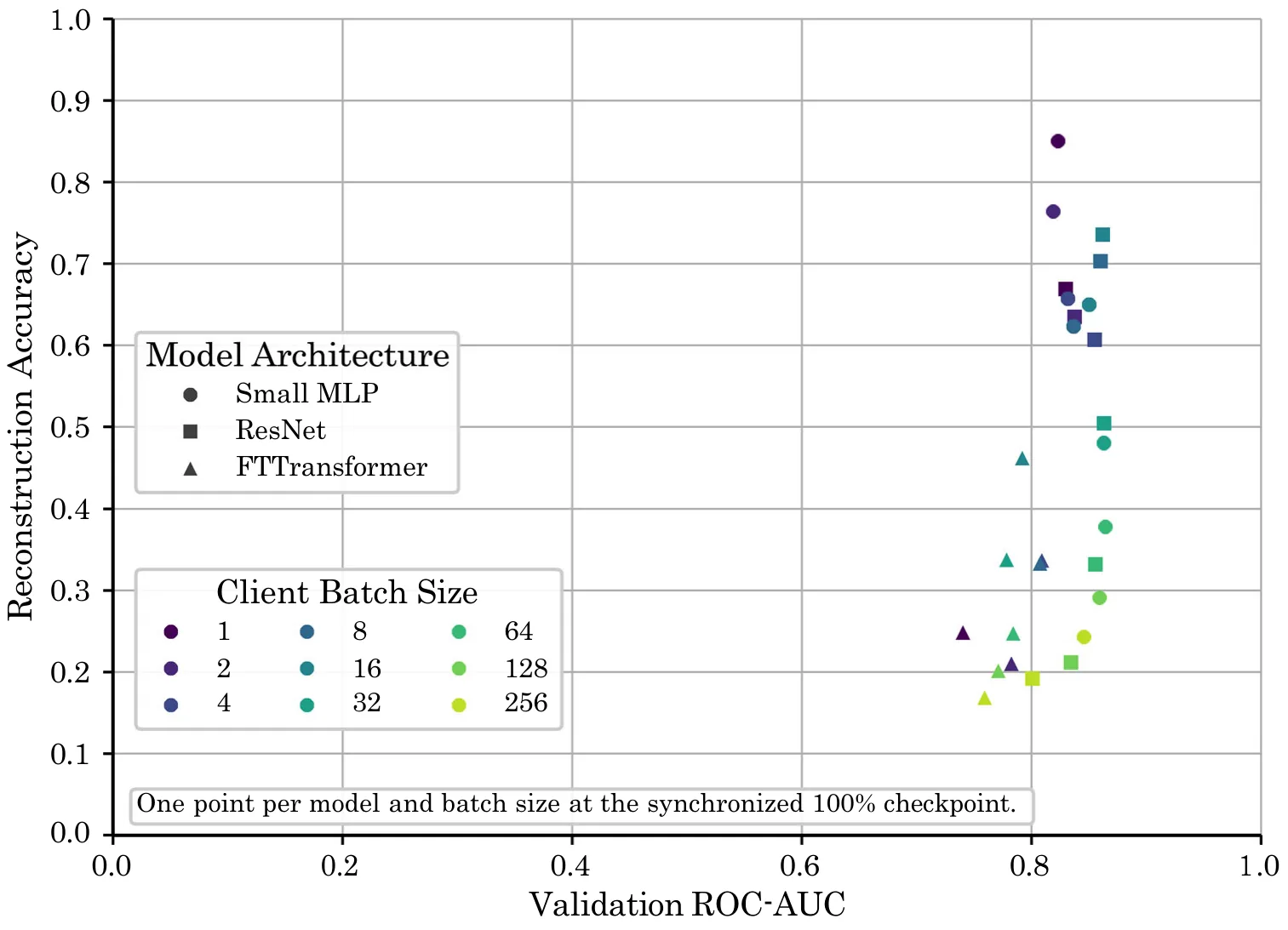
Federated learning lets hospitals and other data holders train one shared model without pooling their raw records: each client sends only a model update, such as a gradient. This paper measures how much of a client's private table an honest-but-curious server…
No paper matches these words.
The team
The lab members who work or worked on this project, with their part in it, and the researchers we work with. See the whole lab on the team page.
Current members 3

Tim Pellikaan
MSc Student · Since Nov 2026
Security of federated analytics

Emil Andero
MSc Student · Since Nov 2026
Security of federated analytics
Past members 2
Ivo Österberg Nilsson
MSc (alumni) · Dec 2025 – Jun 2026
Security of federated learning
1 paper in this project

Maximilian Birr Engvall
MSc (alumni) · Dec 2025 – Jun 2026
Security of federated learning
1 paper in this project
Videos
Short explainers of the research in this project.

Can a Model Update Leak Patient Records?
Federated learning keeps hospital records local, but a curious server can try to rebuild them from model updates. What makes tabular records leak, and what doesn't.
Interested in this project?
We welcome collaborations, data partnerships and students who want to work on cybersecurity ML problems with us.