One lost sock can strand usable wear-capacity and trigger premature replacement. In this study, we take this question mathematically too serious but still fun.
~87.9
Sockless days (Purist / strict matching)
~14.7
Sockless days (Threshold‑Mix)
66–74
Days of feasibility gained vs strict matching
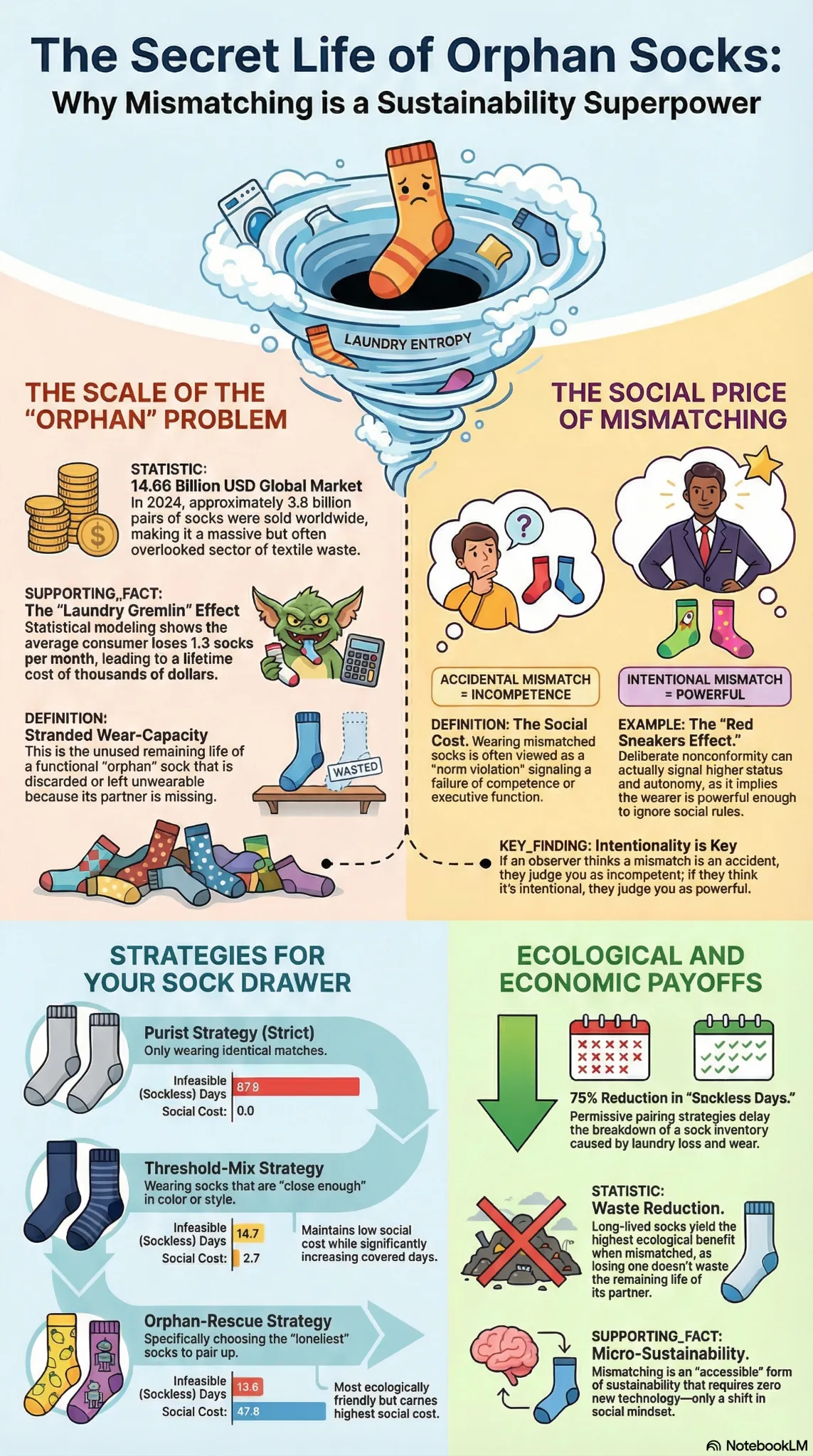
Socks are produced and replaced at massive scale, yet their paired use makes them unusually vulnerable to waste. Losing one sock can make its partner unusable, even if it has plenty of life left.
Mismatched socks can be judged as a “norm violationâ€. If it looks accidental, observers may interpret it as incompetence. If it looks intentional, it can signal confidence and autonomy (the “Red Sneakers effectâ€).
Accidental mismatch
Often perceived as a mistake → higher social penalty.
Intentional mismatch
Perceived as deliberate → can feel stylish/powerful.
Key idea: intentionality is the hinge. The model captures this via exposure + a person‑specific mismatch penalty.
Three interpretable strategies (and the trade‑offs they reveal)
Only wear identical matches. Social cost stays near zero, but feasibility collapses.
Infeasible (sockless) days
87.9
Wear socks that are “close enough†in style or color. Maintains low social cost while staying covered.
Sockless days
14.7
Social cost
2.7
Pair up the “loneliest†socks first. Most ecological — but can be socially costly if mismatch reads as accidental.
Sockless days
13.6
Social cost
47.8
Permissive pairing strategies delay sock inventory breakdown caused by laundering loss and wear. In the reference scenario, allowing controlled mismatch yields roughly a 75% reduction in sockless days compared to strict matching — and reduces waste by using the remaining life of orphan socks.
On the go? hear our podcast about the study. Want to take it like? hear our missing sock rap sound.
Who read papers nowadays? Hit the road or fill the bath (we do not judge) and play our podcast to learn how matching your non-matching socks can make a big difference.
Build your drawer, choose a policy, and see which pair the model recommends today. This is a friendly approximation: we compute a compatibility score (ξ) from color/pattern/length and apply the policy logic.
How likely are people to notice your socks today?
How “costly†is a mismatch for you?
Lower τ → stricter matching. Higher τ → more permissive.
We even made slides - swipe/scroll, use arrows, or click any slide to zoom.